Written by: April J. Buchanan
It is not that men do not speak of God. On the contrary, many speak much of Him. Yet their understanding is not informed by the clear and plain sense of Scripture, but by their own imagination of who they believe Him to be.
Have you ever sat outside a conversation and heard it unfold, where God is much spoken of? Your ear is drawn in, as the heart of the believer is naturally inclined toward such things. For a moment, it sounds as music to the ears. And then you hear it, that once beautiful sound now hits a wrong note and becomes a matter of discernment.
You just want to hear the truth playing beautifully but far too often the sound is not a little off but strikes a false chord and never returns to its once beautiful sound. Each man speaks of God in a way that is meaningful and personal to him, yet not as He has revealed Himself.
Have you ever sat among those who invite you to their table? You are their guest. It is not your table. They are kind, warm, and hospitable. Then they open a supporting text meant to aid in your understanding of who God is. You follow along with your Bible open, yours the only one visible. As you do, you pray for God’s help to see what the text says and means.
There, the text reveals the beauty and glory of God, and your heart rejoices. The words are read aloud. Every man agrees. And then, in the next breath, what was clear is filtered through each man’s heart, through what he feels about God. What stood firm in the text is quickly reshaped in conversation. God is brought low, and you feel the need to steady yourself again upon the text, as though regaining footing in a room that has shifted beneath you.
You are guided according to a god so low you could almost sit beside him, not clothed in the righteousness of Christ, but accepted as you are, as though your sin were no offense. No longer an enemy, but simply one already embraced. Not loved with an eternal, sovereign love, but pitied and remedied, as though God merely saw the problem of man and moved to fix it. What was true in one breath is obscured in the next. The clarity of the text gives way to confusion.
When you speak, some listen as though your words are foreign. Others take offense. Some agree, yet uneasily. Others agree quickly, though it is not clear they understand. And so you find not only error, but uncertainty, truth acknowledged, yet not firmly held.
Many will hear the reading of Scripture. They may even affirm what is plainly taught. Yet their hearts have already determined who God is to them. What they hear is not received with submission, but filtered through what they already believe. Their familiarity is not with the text itself, but with conversations about it, what they think it means, rather than what it says.
You have been trained, as many have not, to go into the text and draw out its meaning. To begin with God, not man. To see that the text does not bend toward the reader, but stands over him. And yet many have not been taught how to approach the Word in this way. They are given methods that subtly move them away from the text itself, so that they do not discover its riches by careful attention, but drift into error. You once were taught like them and even worse than them.
Even the simplest believer, even one of low estate, even the plow boy, may understand the truth of God when the Word is rightly handled. This is no small mercy. The Scriptures are not hidden in complexity but revealed in clarity to those who submit to them.
And yet, though access to the Word is abundant, many have been taught wrongly how to approach it. There is a real struggle in the task of making known the truth, not only because the world resists it, but because confusion often sits within the visible church itself. The bride is often taught to know God by methods that obscure rather than clarify, so that men do not dig for truth in the text, but drift toward error while believing they are near it.
They do not know how to go into the text and draw out its meaning. Instead, the text becomes a starting point, and from it they move quickly into reflections on life, experience, and feeling. What enters the ear as truth comes forth from the lips altered, sometimes subtly, sometimes plainly, because the heart has not yielded. They agree outwardly, yet remain inwardly unmoved.
Guided discussions quickly devolve into error once the words from the page are no longer guiding the discussion but the man who moves away from the guided text, with a closed Bible, speaks from his heart. Many men are not trained in sound doctrine and depend heavily on guided material and once that support is not there and it is on them to lead the way, error is soon to expose the man’s ignorance.
A man may hear, affirm, and even repeat sound doctrine. Yet when it passes through his mind and heart, it is not received as truth that reforms him. It is reshaped to fit what he already believes. When he then tries to teach it he can only distort it for his heart guides him and not the clear and plain meaning of the text.
Thus many hear and agree, yet what a man truly believes about God often proves resistant to Scripture. He will affirm truth in general terms, but when brought closely to the text, he reveals either ignorance or quiet resistance. His agreement is shallow because it is not governed by submission.
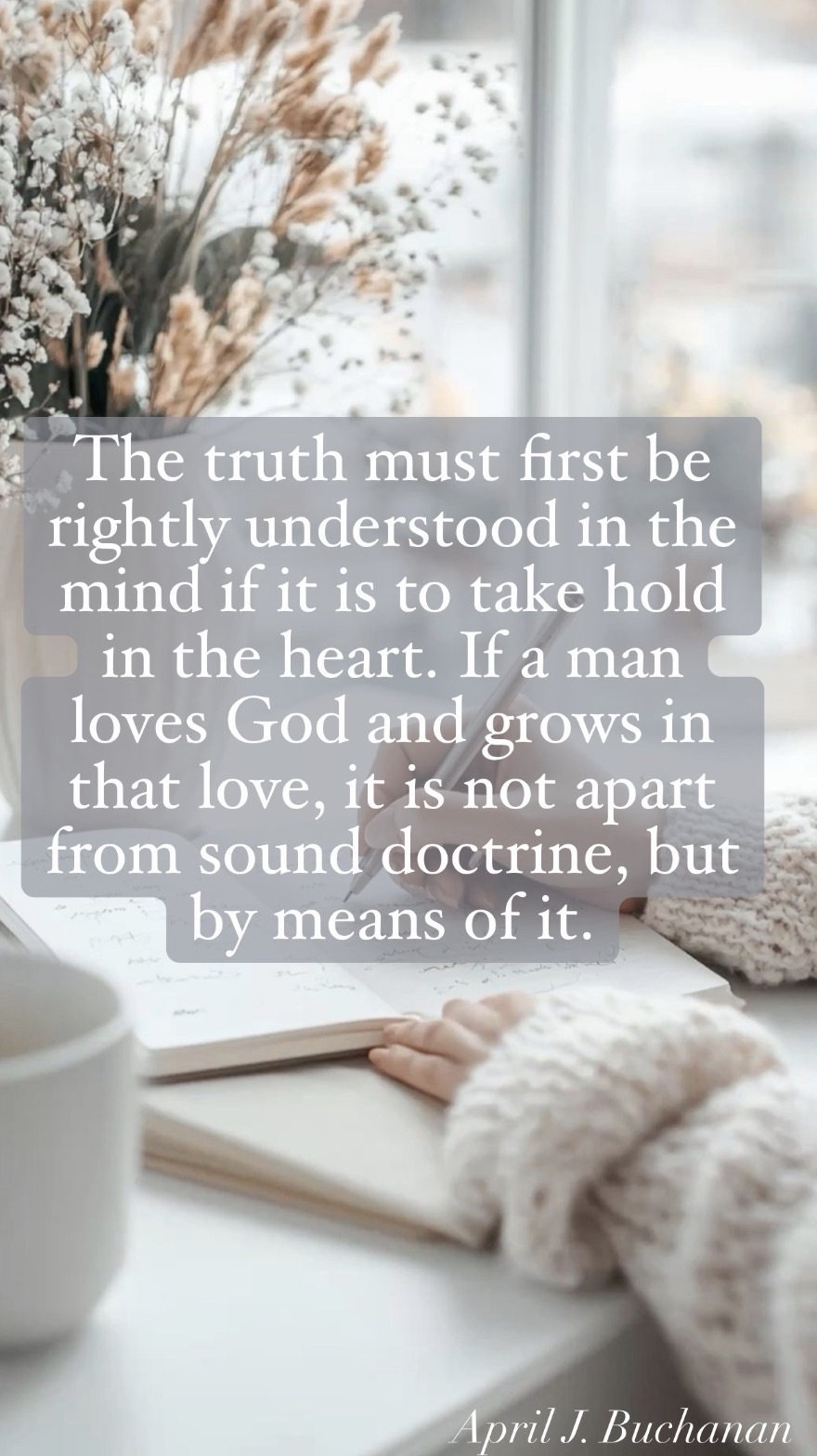
A man may improve his speech while his heart remains unchanged. The truth must first be rightly understood in the mind if it is to take hold in the heart. If a man loves God and grows in that love, it is not apart from sound doctrine, but by means of it.
God is who He is. He does not yield, change, or conform Himself to our understanding. We must yield. Our minds must be renewed according to His Word. And it is there, in the truth of who He is, that we find true comfort, peace, and assurance. Joy, grace, mercy, and hope do not follow from imagining God, but from rightly knowing Him.
He does not bend to our beliefs about Him. He reveals Himself. Where our thoughts align with His Word, they are confirmed. Where they do not, they must be cast down, humbly and without delay, lest we deceive ourselves and others.
Therefore, we must cast down our imaginations and set our minds plainly upon the text. There, and there alone, we behold His glory.
We cannot improve upon perfection. As He reveals Himself, He humbles us. He brings us low, and from that place causes us to behold Him rightly. True knowledge of God does not inflate the man, it lays him low and leads him to worship.
He is worthy of more than what we so often ascribe to Him. Praise Him, not for who you have imagined Him to be, but for who He is. Let your mind be instructed and your heart transformed by His Word, that your praise may be true, and that you may ascribe to Him the glory He alone is due.
 Leaving Beyond - Grounded In Scripture
Leave a comment