• The Forgotten Labor of Meditation: Why the Saints Did Not Merely Read, But Lingered Under the Word

    Written by: April J. Buchanan

    As I often read from those “old dead guys,” or better put, those faithful saints who have died in the faith, whose writings God has preserved for the encouragement of His people, I frequently come across a strong emphasis and instruction: not merely to read, nor even to read much, but to meditate much. Those who benefit most from reading are those who dwell upon what they have read, allowing such meditations to abide in the mind, instruct the life, and lead to actions and obedience to God that are first wrought in the heart.

    Their concern is not necessarily that one reads much, but whether what is read profits the soul. To boast of much reading while showing no benefit from it in one’s life demonstrates that it has never truly worked in the heart and mind, but has merely passed through, leaving the soul unchanged. This counsel, I find to be of great benefit.

    I think also of the words and examples of faithful saints who have both practiced and commended this principle. Susannah Spurgeon would take a single verse and turn it over throughout the day, letting it abide in the mind in sustained meditation. I think of Thomas Brooks, who urges the reader to meditate much upon what he reads, so that the actions which follow are shaped by a mind and heart formed by truth. I think even of the careful discipline of study among faithful pastors such as John MacArthur, where even the simple act of pausing, leaning back in the chair, becomes part of a deliberate labor of understanding, giving space for the text to be rightly considered before God.

    There are many faithful saints who have both practiced and commended this principle: meditate upon the truth. Let it settle. Let it turn over within the mind. Pray to God for understanding. Sit under the text, and give the soul space to be taught.

    Pride leaves little room for such meditation, for it already knows what it intends to say and is unwilling to be changed or counseled otherwise. But the one who lingers under the Word and rises with its work upon the heart, having turned it over in the mind and sought understanding in prayer, is the one most prepared to be changed by it and to be truly profited.

    For I love to read, and I love to read much. I enjoy keeping track of my reading. I enjoy setting reading goals. And I do not only read what benefits the soul, but where some might entertain themselves with television or other mindless amusements, I often do so with a book. I read more of these kinds of reading for passing enjoyment, as they are easy to travel through, visit for a time, and then move on to the next. Yet those books that do a greater work upon my soul, I am learning to visit fewer of each passing year. And when I do read more of them each year, I sometimes fear that I have allowed a reading goal to hinder a better work in my own heart.

    I write. Why do I write so much as I read such books? As I do in all things, I suppose. I do not always write knowing the subject upon which I desire to write. More often than not, I sit before a blank screen with no idea what I shall write. I only know that I must. Therefore, I write.

    And as I do, I often find that which I have meditated upon comes out in my writing. It reveals my own heart. My own meditations. My writing often has a way of exposing what has occupied my mind. What then have I meditated upon? What then have I scrolled upon that has struck my heart and poured out through my pen?

    As one who loves to read and write, my pen does not much rest, nor does my mind. I meditate much. Oh, that I should be far more careful concerning that upon which I meditate.

  • The Deception of a Divided HeartWhen What Seems Good Begins to Oppose What Is Right

    Written by: April J. Buchanan

    Oh contrary thoughts, woe to the soul and stumbling blocks along the path of righteousness and assurance. You that cloud judgment and sow discord in the heart, making it feel torn between two good things, when one is always the right path. For any way that leads from the right path, while it may not be inherently bad, when setting itself against the way of righteousness shows itself an enemy. Good it may be in the way of righteousness; an enemy it is when setting itself in opposition to it.

    The path is clear. The way is good. Any good thing setting itself in opposition to what is holy, righteous, and good must either submit, or the path has made itself clear. The mind and heart are set in conflict not by truth, not by holiness, not by righteousness, but by whatever has set itself in opposition to them. There lies the conflict.

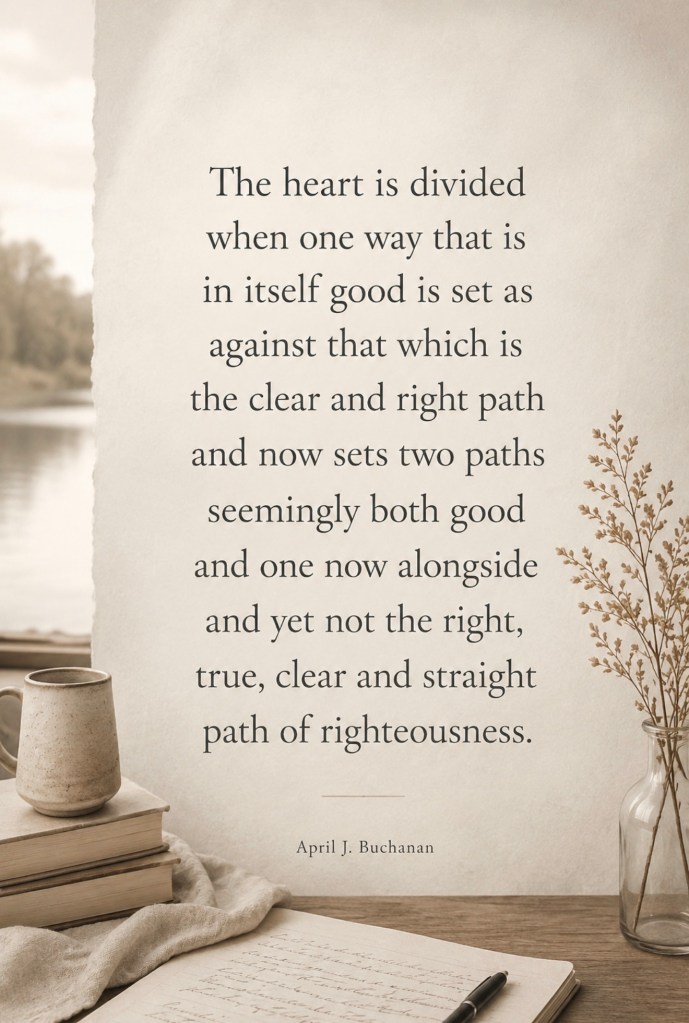
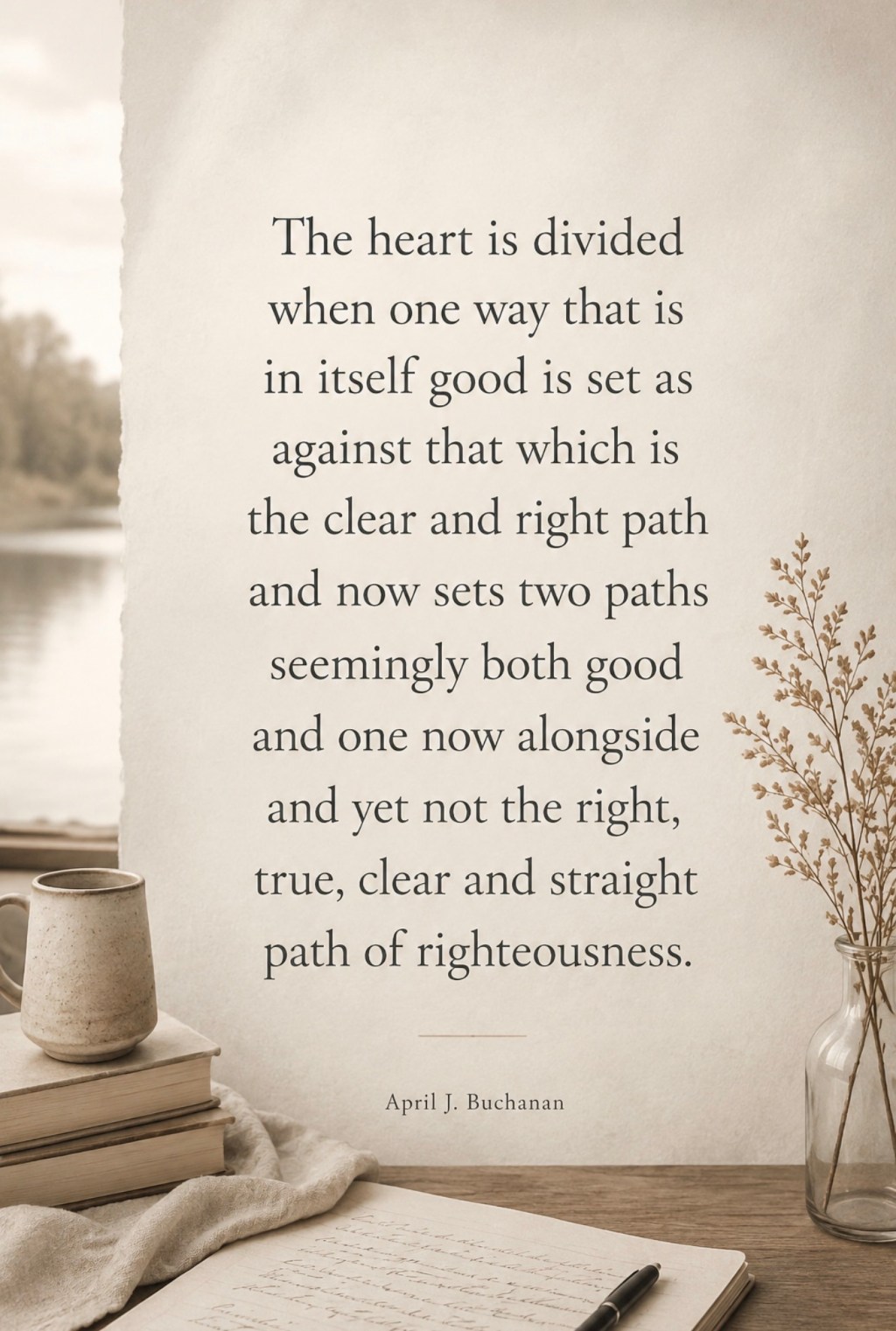
    The way of truth is straight. The way of righteousness is plain. The heart is divided when one way that is in itself good is set against that which is the clear and right path, presenting two paths that seem good, yet one stands alongside and not upon the right, true, clear, and straight path of righteousness. Conflict exists in the heart and mind where what is good is corrupted and set against what is good and straight.

    Dear saint, be wise and careful in such reading, for to stretch it beyond its bounds is to justify wickedness already decided in the heart and seeking an exit God has not provided. Rather, He has called His precious saints to endure hardship, trials, and sufferings by means of His gracious providence and His wise and good plan for them.

    The way that is good is not always painless. Make wise use of the text of Scripture, that the heart and mind may submit to the will of God in all things, and that whatever looks good or feels good, yet is set in conflict with what is right, holy, and good, may be exposed for what it is. Then may the way of righteousness and holiness be set before the eyes, the mind fixed upon it, the heart submitting to it, and the path walked in faith and obedience, trusting the God who is sovereign and wisely working all things for good and for His glory.

    The mind may be deceived. If one thinks it cannot, he is already deceived. Set the mind upon God’s Word and pray, dear saint, for the way which seems right to a man may lead to his ruin. We are skilled at deceiving ourselves and convincing ourselves that what we desire is God’s will for us. Pray for wisdom and a heart to obey.

  • Conviction Was Never Meant to Be Your Home: The Purpose of Seeing Your Sin Is to Flee to Christ

    Written by: April J. Buchanan

    Oh, what a terrible wretch am I. What mercy could possibly be shown to one such as me? My soul is impoverished and wicked, and my sins are many. Oh, they are many indeed.

    Where may I rest my head? It seems that just as I think I might find hope, I am seized once more by despair. Yet I cling to it, for it shows me rightly what I am. It testifies truly concerning me, and I agree with its judgment. I find no comfort, no hope, as I look so deeply upon my sin. All I see is this wretch staring back at me.

    Despair. Woe. Misery. They have consumed me. My soul stands arrested by their judgments. I find myself exactly where I belong.

    Pass on by, traveler. Look not upon me. I cannot bear your mercies and pleadings. My soul is vexed and persuaded that this darkness is its rightful dwelling place.

    The miserable wretch who sees his sin rightly, yet will not look upon Christ, has made his misery and chains his welcome lot. He dares not hear the words of life, the saving power of the gospel of grace, for freedom, life, and peace with God would strip from him the chains he is not only held by but now clings to.

    Oh dear man, it is not enough to hear of your wretched state and accept it as your lot in life. You may confess how filthy a sinner you are. You may even agree with every warning spoken by the evangelist. Yet will you close your ears to his proclamation of grace? Grace. Amazing grace.

    Do you despise the Beloved? Does His grace so offend you? Will you not hear His call and flee from your sin? Will you not fly to Him in saving faith? Will you not cast off your chains and throw yourself upon His mercy, finding Him faithful and gracious, mighty and willing to save your wretched soul?

    Think you greater of your sins than so great a Savior? Oh wretched soul, looking so long upon your sin, will you not turn and behold Christ? Will you not hear and fly to Him who today saves and tomorrow shall judge?

    Today. Today is the day of salvation. Turn. Hear. Fly to Him while you may.

    For when your soul goes down to the grave, it shall find not rest but the fearful expectation of judgment. Perhaps you know this. Perhaps you have dwelt so long upon your sins that you can bear nothing but terror. In some dreadful way your soul has become acquainted with despair and has learned to love its company.

    Yet despair was never meant to be your master. Conviction was never intended to be your resting place. The knowledge of your sin was given that it might drive you to Christ, not keep you from Him.

    Hear! Will you not hear Him? Come unto Me, all who are weary and heavy-laden, and I will give you rest. Turn. Fly to Christ that you may be saved.

    Your sins are not too many. Your guilt is not too great. You think far too highly of your sin and far too little of your Savior.

    Look to Christ. Will you not look upon Him and find Him holy, beautiful, merciful, and willing to save your wretched soul? Will you not behold the Lamb of God who takes away the sin of the world? Will you not see in Him a Savior greater than all your guilt, stronger than all your chains, and richer than all your poverty?

    Look unto Him and live. Grace. Grace. Amazing grace.

  • Reading Scripture: Christ or the Self? How modern interpretation often shifts the focus from the glory of God in Christ to the improvement of man.

    Written by: April J. Buchanan

    If the mind abide in truth, there are we influenced by grace that exposes in us that which remains against Christ.

    What we read concerning theology has real influence over how we understand who Christ is, who we are, what Scripture means, and how the Spirit works in our lives.

    Much material is readily available and claims to be able to help us in our understanding of who God is and what Scripture says and means concerning our lives.

    The overwhelming majority of what has been written and sits on “Christian” bookshelves and is meant to support our growth and that of all ages is man-centered and merely baptized in spiritual language, but not much different in function than the New Age section or other religious material that aims at self-improvement. That is no indictment on Scripture or on who God is or the true work of the Spirit.

    The Word of God stands in stark contrast to much of what is claimed about it and to much that claims to help others in their understanding of God and what He says about them.

    Many think themselves to have insight and revelation that will benefit others in learning more about who they are and improving their lives. They think themselves spiritual and to have a unique relationship with God based on experiences and encounters, so as to be able to teach others who they really are in Christ and what God wants them to see about themselves, things they believe are hidden but merely need to be believed and brought out.

    That is not what Scripture teaches. There is not something great in us that the enemy is trying to keep us from seeing. We are not basically good. God is not merely trying to get us to see how wonderful we really are or to release something great within us. No.

    We are sinners before a holy God. We are enemies of God (Romans 5; Ephesians 2). We must be born again. Christ came into the world to save sinners and reconcile sinful man to a holy God. He is the hero in the story. All those men in Scripture of whom we see great moments in their lives, set in contrast to their great failures, are intentional. Those moments are not given for us to seek to replicate our own greatness. They point to Christ. Their failures remind us of what we truly are, and that Christ is our only hope.

    Men isolate those heroic moments and lay upon us the burden that we must seek to tap into something great within us so that we too may be like them in their best moments. They miss the point entirely. Those moments point to Christ, who is the true and better fulfillment of all we read leading up to Him. He is the hero. Christ. Not me. Not you.

    When we read all that comes before Him, we are looking ahead as they did. When we read of His incarnation, His life, His death, and His resurrection, we see the fulfillment of what they waited for. And now we look back, seeing that fulfillment, and we look ahead to the promise of His return and His kingdom consummated.

    It is all Christ. We look to Him. We find our hope, our life, our salvation, and our assurance in Him. It is not that we go to the text seeking what it says about me and how I can be the hero of the story. No. We go and seek what the text says and means, and we are careful to consider its place in redemptive history. Christ. We seek Christ.

    We need not mere improvement. The story is not ultimately about us. It is about Him. It is about the perfect plan of God unfolding throughout history and our place within that redemptive unfolding. We are not the heroes. We are those who sinned against Him, and He came into the world to save sinners, reconciling men to Himself, and by whom the Spirit regenerates, baptizes, sanctifies, seals, and fills His own.

    The triune work of God in salvation is evident throughout all of Scripture.

    We either go to Scripture to learn the truth and behold the glory of God, having our hearts and minds shaped by it, or we go seeking what elevates man and ultimately can do nothing but diminish God. Much that is labeled “Christian” literature tends toward a distorted view of man and God, often shaped more by therapeutic moralism than by the text of Scripture itself.

    Do we know and love the God of Scripture, or do we seek a god shaped by the desires of the human heart, a god who affirms us as we are, rather than the God who confronts us in our sin and reveals Christ as our only hope?

    Oh friend, Christ is beautiful. He is wonderful. And we may only behold His glory as we come rightly to Scripture, as the Spirit leads us into truth and reveals Him as He is.

  • The God We Cannot Reduce

    Written by: April J. Buchanan

    If God’s grace were in any measure weak or impotent, then I would exhaust it before the evening. His grace cannot be exhausted. His mercy does not end. His wisdom has no beginning and no end. For He is God. He is God eternal, God immortal, God self-sufficient, God all-powerful.

    If I consider Him in all His ways through my own weakness, even in those communicable attributes of God which we reflect in part as His creatures, and seek to understand Him by beginning with my frailty, what utter despair shall seize me before I take my next breath. For a god like me is a god unworthy of worship and merely a little better than myself. My mind cannot conceive of a god worthy of worship. He must reveal Himself as He is.

    Yet when He does, it is in me to reject Him or shape Him into what my wicked heart would like Him to be. For in His holiness, His righteousness, His sovereignty, His wisdom, and His power, He terrifies my soul. I cannot stand before Him as one who is completely known, with all I have sought to cover, put out of my mind, or justify in myself exposed fully and perfectly before Him.

    Such a God is too terrifying to the finite man born in Adam. It is far more comforting to bring Him low, to make His attributes serve my desires, and to elevate His mercy, grace, and love to a place where His justice, righteousness, and holiness are not satisfied but set aside.

    The mind of man is hostile toward such a holy God. We cannot bear it. We cannot tolerate it. We cannot let God be God.

    And yet He has set His love upon a people from before the foundation of the world. The Father sent His Son, who entered into the world He created and put on flesh, adding humanity to His deity. He lived the righteous life we could not live, died the death we deserve, rose again on the third day, and now, seated at the right hand of the Father, makes intercession for His own.

    At the cross, the full, undiluted wrath of God was poured out upon Jesus. If we can look at the cross and not see the love of God as well as the wrath of God, then we do not see it rightly.

    The mind is hostile to the truth and hostile toward God. Yet in His mercy, God calls out His own, and this call is effectual. Through the external call of the Gospel, the Spirit works inwardly, regenerating those who are dead in sin, making them alive in Christ, and they respond in repentance and faith. A new heart He gives them.

    And yet we are justified. This is a declaration. It cannot be changed. This must not be confused with sanctification. We are declared righteous by the perfect righteousness of Christ. And yet we are being sanctified. How? By the Word of God.

    We must remain in the Word so that our minds may be transformed by the truth. For we are no longer enemies of God, though our minds still battle the remnants of sin and deceit. God has changed our hearts, and He continues to transform our minds through His Word. We learn who He is through right teaching, right study, and therefore the right application of His Word.

    To listen to music, teaching, or read books by those who are not doctrinally sound has an effect upon us whether we wish to believe it or not. We cannot worship God rightly if what we consume is shaping our thoughts toward a perversion of the truth, toward a bent that sounds Christian and spiritual but is false and full of serious error.

    How important is it that we hear the truth and commit our lives to sound doctrine? There is nothing more important. If we are to know God for who He truly is, and if our hearts are to rejoice and delight in Him, then our minds must be informed and transformed by truth, by sound doctrine.

    Do we love God? How are we commanded to love Him? With all our heart, mind, soul, and strength.

    Yet often the mind is abandoned to men’s imaginations while the heart is gratified through the pursuit of feelings and impressions. Men’s faculties become consumed with seeking a god of their own imagining while convincing themselves that they love the God of Scripture.

    Many are convinced that if one has received a second baptism of the Spirit, of which Scripture does not teach, then he may now trust what he feels in his heart or what comes to his mind as special revelation exclusive to those who possess a greater anointing. They are deceived.

    There are no second-class Christians. If one is born again, he is baptized by the Spirit, indwelt by the Spirit, sealed by the Spirit, and enjoys the ongoing work of the Spirit within him, whereby he is also being filled by the Spirit.

    If we believe there is a special class of Christians who have access to special knowledge through a unique anointing received by a second baptism foreign to Scripture, then we have gone beyond Scripture and have begun to treat what we feel in our hearts and what comes to our minds as possessing authority alongside Scripture. Here many err.

    The Spirit is not giving new revelation. Rather, the Spirit works in the hearts of all who are truly regenerate by illuminating the meaning of the text He inspired. The Spirit of God does not work apart from the Word but by means of it.

    To separate the Spirit from the Word is to invite deception. The same Spirit who inspired the Scriptures now works through the Scriptures, opening blind eyes to understand, receive, and delight in the truth. He does not lead His people beyond the Word He has given but continually leads them deeper into it.

    Many show themselves hostile toward God as He has revealed Himself in His glory and in His governance of the church. Men have their own ideas of who God is, what He is like, and what they believe the church ought to be. They know not God, nor do they worship Him as He is worthy.

    Many worship. Many gather together in the name of God. Yet they know Him not, nor do they worship Him rightly, for their minds are not transformed by the Word so as to see Him as He has revealed Himself and to worship Him according to His appointed order. Rather, they worship Him as they imagine Him to be, feel Him to be, and think Him to be.

    They worship a god fashioned by their own foolish hearts and know not the terror Scripture reveals concerning false worship and idolatry. Such worship soothes the conscience for a time. Yet when they meet the God of Scripture and stand laid bare before Him, they shall find Him holy.

    May they then learn of that grace which leads to repentance for all they have done falsely in His name. May they be led to the truth, that they might truly hunger and thirst for righteousness, which is found only in Christ and in His Word.

  • God of My Righteousness

    Written by: April J. Buchanan

    Oh God of my righteousness, I praise Thee all the day. For in Your Word I find strength, grace, hope, and every assurance and confidence in Christ. And in Your Word I behold the terrifying and fearful judgment of the wicked, that judgment every man deserves. Where else may I fly, and to whom else shall I desire to run, but to that grace which is enough and immeasurable, to my Lord whose righteousness is perfect?

    I read of Your judgments and know they are good. Yet to delight in them is also to know that to be judged by them apart from Christ is good and just, a reality many shall endure. Oh God of my righteousness, where else shall I fly? To whom else should I desire to go? You are my God. You are the God who judges righteously. You are the God who has indignation day and night, and this my soul knows is good. You are righteous and holy, and in this my heart praises and rejoices.

    And knowing myself more for who I truly am, as Your Word reveals, and knowing who You are as You have made Yourself known, I fly to You and take refuge in the God of my salvation, the Lord my righteousness, my hope, my life, my all. Oh God, should man not repent, You sharpen Your sword, and every man stands justly condemned before You.

    Oh God, my God, You are righteous and just, holy and true. You judge in righteousness, and I have none of my own. But You, O God, have clothed me in the perfect righteousness of Another. One worthy. One perfect. One holy. Christ my righteousness.

    I will sing with the saints songs of praise to my God, who plucked my life from the destructive path upon which I walked to my own ruin; who called me and loved me before the foundation of the world; who took my place of punishment, bearing the full wrath of God for my sins, and who clothed me in Your own righteousness. You took out my heart of stone and gave me a heart of flesh.

    I can never praise You as You deserve. Let all eternity sing Your praise, for You alone are worthy. My God, my God. God of my righteousness. I praise You alone.

  • Hardened Hearts and Softened Messages: The Danger of Seeking Results Over Faithfulness to the Sovereign God

    Written by: April J. Buchanan

    For often we think the hardened man to be a cruel and dangerous man, only that kind of man whom you do not make eye contact with and do not engage with. And yet Scripture teaches of men whose hearts continue to be hardened in their rebellion against God. They celebrate wickedness, delight in evil, and encourage others to do the same. They suppress truth in unrighteousness and do not want to have God in their minds.

    Men of hardened hearts are not always marked by scowling attitudes and a presence that is almost tangibly off-putting, as if they walk about with a warning label attached to their heads.

    More often they are very present and actively involved in culture wars, mocking Christians while claiming a morally neutral or more often morally superior position. They welcome professing Christians so long as they abandon the authority of Scripture and are willing to accept others in their sins. I will not say sinful lifestyle choices, as that is merely a manifestation of a far greater issue: their sinful nature, which they love and desire to please, showing themselves enemies of the truth and unwilling to accept, tolerate, or put up with those who love them enough to share the Gospel with them.

    Many Christians today know not the dangerous shift over the last several decades whereby men have slowly eroded true evangelism and introduced what the world has said it will be open to, accepting of, and maybe even willing to profess faith in. Modern evangelistic efforts are often identified more by pragmatism, which will never reach a dead heart, but instead appeals to the sinful nature and its desires. Many are reached by pragmatic evangelism, and it has led to many false converts in the church.

    The first step was to ask the world what it would be willing to receive. The next step was to change the identity of the church to meet those pragmatic demands of the world. Then the church itself became the primary place for pragmatic evangelism. With sound teaching replaced by messages designed for the world, those who were truly being saved were not growing according to sound doctrine. The result is profound biblical illiteracy within the visible church on such a scale that it would almost seem as if such men had found the perfect way to undo the Reformation within the walls of the visible church itself.

    And such men seek not true reform according to the Word of God, but continue on in pursuit of vision casters and church growth gurus for the newest and most effective way to reach the lost. It is almost as if God gave the early church a method and it worked for a while, but He failed to give a method that was sustainable, powerful, and effective for all the church for all time.

    Men of hardened hearts mock such shallow Christianity and lump all of it together. The most visible version of what is called Christianity before the eyes of the watching world is made up almost entirely of that which is false, counterfeit, and exactly what Scripture, when set against it, shows to be errant and even heretical.

    The church is not a goat farm. It is primarily for the saints, and though the unsaved are welcome, we will not change the church for the lost. And that is just as much for their sake as it is for the sake of Christ’s Name, His bride, and the purity of the Gospel. If we truly love the lost, we will not change the church, the Word, or the Gospel, but will love them in the truth and pray that God may save them.

    Hardened hearts are not changed by felt-need, therapeutic messages alongside emotionally manipulative music and dark lights, as well as other pragmatic methods that attract and please the sinful nature. Such methods produce many false converts who identify themselves with Christ and His bride while having no part in Him or with her.

    Men of hardened hearts are those in rebellion against God, and many of them are in pulpits and pews thinking themselves right with God and yet are now far worse enemies of His than before someone invited them to their church where they heard a watered-down, man-centered version of the Gospel. Why invite them instead of sharing the Gospel with them? Because many in the church know not how to share the Gospel and place their confidence in an invitation so that the lost may come and “experience God” through dark lights and emotionally manipulative music that makes them feel seen by God, only then to hear the pastor preach a message designed to feel personal and as though God is speaking directly to them. That was the design and intent after all.

    Church is no longer for the saints and for the worship of God. It has become about a personal encounter, personal experience, and personal word so that the lost man can feel as though God sees him and has simply been waiting for him to accept Him into his heart. This is why so many will say, “If you would just come to my church, then you would believe because you would have an experience.” The Gospel becomes limited to their church where everything has been designed around the lost man, what appeals to his sinful nature, what attracts him, and what will give him an experience he will never forget.

    That hardened sinner may break and cry, having a real experience that he believes to be God. And he will ask Jesus into his heart. Yet he is now worse than before he entered. His heart, moved by an experience, continues to sit under those dark lights and man-centered messages craving another experience and hearing messages that make him feel special and as though God needs him or else He cannot do what He has planned to do. His heart, still hardened, is now learning language that sounds Christian but places him in a new category within Scripture. He is a false convert, and he will do more damage than ever he had before.

    Hardened hearts are not impossible to reach if God is truly sovereign in salvation. And He is! Therefore we trust not in men’s newest schemes and devices, nor do we prostitute Christ’s bride to win the world. The church is for the saints to gather together in worship to God according to the means and order He has set. She learns and grows, and as she is scattered she evangelizes the lost.

    The church is not the primary place of evangelism. Our homes are. Workplaces are. Communities are. The Gospel needs no gimmicks or schemes of men in order to be effective. God’s Word is powerful and effective and needs only to be proclaimed faithfully and with genuine love and concern for every soul. Not manipulating hearts, but proclaiming truth whereby the Spirit works and regenerates men dead in sin.

    Men of hardened hearts are those in our lives whom we love and those we pass by each day who are growing not in grace but ever more hardened toward God. When they hear the Gospel it will not always result in the way we so desire, and sometimes their hearts will be hardened even more as they hear it. This must not lead us to change the message in an effort to reach their hearts. We must trust God with the results and examine our own hearts before dealing with so precious a soul.

    Do we love them? Do we care for their soul? If so, we will not employ methods that appeal to their sinful nature, knowing it for what it is. But we will trust the God who saves and be faithful messengers with real love and concern for the lost, proclaiming the message He has given us and trusting the Spirit to work in regeneration.

    Friend, we can trust God with hardened hearts. Did we not find His grace and mercy sufficient in our own?

  • The Deception of the Self: Pride, Despair, and the Need for Grace

    Written by: April J. Buchanan

    A man left to himself may come to ruin, for the inward corruption of the fall brings forth what it will when unrestrained. One man, burdened by inward thoughts of darkness, comes to see himself as worthless and without hope. He lingers there, and his thoughts become destructive. Another man, convinced of his own strength and sufficiency, sets his mind upon the things of this world and finds his joy within them. In seasons of ease he is satisfied, and in seasons of trouble he labors to restore what will again bring him pleasure. His decisions in business, health, relationships, and civic life are shaped by what most secures his temporal happiness.

    The man consumed by misery is often despised by others, regarded as a burden to society, weak and unprofitable. Meanwhile, the man of confidence in himself is praised. He speaks of his contributions, his goodness, his service in religion, in public life, and in acts of charity. His thoughts are high concerning himself, and so he concludes that he is good because of what he does. In his own eyes, little more is required.

    Yet the one who has fallen into despair believes himself closer to truth, thinking he has seen the vanity of all things. Having examined himself and found no worth, he refuses comfort, unable to reconcile any hope with what he believes himself to be. And yet even here, he does not step outside himself; he still judges by inward reasoning rather than by the testimony of God.

    Thus both are deceived by hearts not rightly measured. Neither has been weighed against the perfect standard of God. Both are measuring themselves by comparison with men or by their own inward reasoning. Neither has been brought low before the holiness of God, where true knowledge of the self is given and mercy in Christ is revealed.

    One exalts himself through accomplishment; the other collapses inward through unbelieving despair. Yet both remain centered upon themselves. Both turn inward rather than upward. Both stand, in different forms, as an offense to God, whose holiness exposes every false measure and whose truth alone defines what man is.

    For though sin has corrupted all through Adam’s fall, God remains sovereign over all, governing all things according to His holy will and purpose. And only when life is found in Him does anything cease to be meaningless.

    The soul that trusts in itself, whether in pride or in despair, remains outside the knowledge of grace. For the issue is not the presence of sorrow or confidence, but the absence of truth applied by God to the heart through His Word.

    Apart from the revelation of Scripture, man does not see himself rightly, nor does he see God rightly.

    But when a man is brought low before the holiness of God, both false confidence and unbelieving despair are broken. He discovers that he is worse than his despair had shown and more guilty than his pride had admitted. Yet he also discovers that grace in Christ is greater than both.

    There he turns in repentance and faith, not by his own resolve alone, but as the Spirit of God grants life through the Word, uniting him to Christ. In this union, Christ is not only the object of hope but the source of new life itself.

    From that point forward, the Christian life becomes a daily mortification of remaining corruption, carried out not in self-reliance but by the Spirit working in the believer. When sin rises, whether in pride or in despair, it is met not with trust in the flesh but with repentance and renewed dependence upon grace already given.

    For the one who belongs to God learns this continually: his weakness is real, his heart is unsteady, and his thoughts are prone to both pride and despair. Therefore he sets his mind upon the Word of God, abiding there. And as he does, he is sanctified by truth, upheld by grace, and preserved by the power of God.

    And though he is weak, Christ is strong.

  • The Hidden Source of Many Sorrows

    Written by: April J. Buchanan

    Some of our greatest sorrows and deepest troubles are not external, though we are often quick to ascribe them as such, but are self-inflicted. Many are eager to blame circumstances, other people, or providence itself, while seldom stopping to look rightly at their own hearts. And if a man continually determines that his troubles are always the fault of something outside himself, never learning to examine himself truthfully before God, he will continue in the very patterns that bring misery upon his own life, and his heart shall grow hardened all the more.

    There are many doctrines that teach a man to obsess over external enemies by means not taught in Scripture. If a man can be made busy seeing a demon behind every bush, believing all his troubles to be caused by some external force, or imagining himself constantly opposed because of something supposedly wonderful within him, then such a man may become puffed up in his perception of himself while never becoming acquainted with the grace of God in true sanctification. He may never behold the beauty of God rightly, for he thinks himself so important that threats must surely surround him because of who he is.

    Men naturally gravitate toward doctrines that are pleasing to the wicked and deceived heart. Broken and wounded men often seek refuge among those who know not true humility nor grace wrought deeply within, but rather among those who take the broken and leave them worse than they were before.

    If God’s Word be not central and set plainly and rightly before the hearts of men, they shall never be wounded rightly nor healed truly. Instead, the wounds they bring, making themselves victims, are treated with a poison disguised as medicine. Slowly they die from it, yet become so intoxicated with its pleasures, promises, and praises that they no longer see themselves rightly and despise the very words that warn them.

    It is impossible to grow in godliness, holiness, and that which is truly good and ordered if we first do not have Christ, and if we then do not continue looking into His perfect Word so as to see ourselves rightly. We must be humbled by the truth, repent of our sins, and be conformed more and more into the image of Christ as we desire to be like Him.

    Oftentimes many professing Christians wish to be free from sin and its consequences, yet do not wish to reckon with the man who sows so much of the pain, sorrow, trouble, and disorder within his own life. But if we see ourselves rightly, we shall find enough corruption of our own to mourn over, a man needing to die daily, and a Savior all the more gracious and wonderful.

    Dear saint, while there are indeed external threats, false teachers, wolves, temptations, and spiritual dangers of which Scripture warns and which must be dealt with biblically, our greatest danger remains within our own hearts. We must therefore attend daily to those gracious means God has appointed to keep us seeing Him rightly and ourselves rightly.

    Providence is not against us. It is the beautiful outworking of God’s sovereign will in all things. Often our troubles are not external. They are our own doing, for which we must take responsibility, repent, and walk in truth.

    “The heart knows its own bitterness” (Proverbs 14:10). And if sin, pride, self-will, and bitterness are not daily crucified, so that the exceeding beauty and truth of God’s Word may have its proper work within a tender and humbled heart, then that man shall continue in misery until he is humbled beneath the weight of his own waywardness. Either he shall be brought low and taught to forsake himself, or it shall be revealed that he was never born again at all, but merely clothed in the language and outward appearance of a faith he never truly possessed within.

  • Joy Wrought by Grace in the Life of the Church

    Written by: April J. Buchanan

    Be joyful, a command not forced, but that which is wrought within by the gracious work of God. How can the saint be joyful? Is he able? Yes. As he attends to the means of grace, what is unnatural to the flesh becomes the visible work of God within. The man who walks in these means finds his joy in the Lord, whatever his circumstances.

    Such things are not natural to us. We are not born content, joyful, or marked by genuine love and affection that glorifies God for one another. These are evidences of grace at work in the man who has been born again.

    How might this church have rejoiced upon the reception of this letter? I know not. I am certain that they rejoiced much.

    Joy becomes a burden to the heart that is commanded to rejoice apart from the gracious means of God, where joy is spoken of but not defined biblically or received as the fruit of grace. The command itself feels heavy to the flesh that is concerned only with its own interests. But such commands are not burdensome to those in whom God is at work, whose love is increasing more and more. In them, obedience becomes delight, and duty becomes joy.

    This church was near to the heart of Paul. Philippians is not primarily a letter of rebuke. They were not marked by serious disorder or corruption. While Paul does warn them against external threats of false teaching, especially Judaizing influence, they are not a church characterized by internal doctrinal breakdown. They were a church that had faithfully helped Paul in the furtherance of the Gospel from the first day until even as he wrote this letter. And when they lacked opportunity to help, it was not because they cared not for him or withdrew themselves from his needs, but because they simply lacked opportunity. As soon as they were able, they supported him and helped him in his need.

    In this letter, Paul’s love for them and their love for Paul is evident. He wrote to encourage them even while he was in chains. He wrote to assure them that even in his imprisonment, the work of Christ was not hindered but advancing. He wrote to share with them his joy in what God was doing.

    It is one thing for a church to send money in aid and support of another, yet never pray for them again, never truly consider them in their labor, but merely feel satisfied in what they have done through monetary giving. This was not so with these precious saints. They cared for Paul and for the work of the Gospel. And when they heard of his chains, Paul wrote to encourage them that the work of the Lord had not been chained, but rather that his imprisonment had turned out for the furtherance of the Gospel.

    This mutual love, affection, concern for one another, and devotion to the work of the Gospel is beautiful to read. And it is right that it stirs the affections. But those affections are not an end in themselves; they are meant to be formed by truth and directed toward Christ. This is what the church looks like when she is concerned not only with her own interests, but with the interests of her Lord, His bride, and the work of the Gospel.

    Is the letter this simple? Yes. Is it far more? Yes. Do we behold in it some of the most beautiful revelation of Christ, especially in Philippians 2, where we are given one of the clearest displays of Christ taking on flesh? Yes. And in the passage where the warning exists against external corrupting doctrines, we also find some of the most piercing contrast between the righteousness of man and the righteousness of Christ.

    There Paul, once confident in his own standing under the Law, counts all things as loss for the surpassing worth of knowing Christ Jesus his Lord. What once defined him, his lineage, his zeal, his righteousness according to the Law, he now considers loss and even refuse compared to Christ. This passage is not merely a warning against false teaching and worthless righteousness, but a necessary contrast that reveals what we truly are in ourselves and magnifies the perfect righteousness of Christ, which is received through faith.

    This little epistle is not demanding joy, it produces it as the Spirit uses it in the hearts of God’s people as they read it, enter into it, and come out of it being formed by its truth. Whatever circumstance we are in, if we are Christ focused, Gospel driven, and unified in the work of the Gospel and in love for one another, then we rejoice when we hear of what God is doing, wherever we are and whatever our circumstance may be, for the sake of the Gospel.