To what, O soul, do you find beautiful? Christ? And how have you counseled yourself in who He is? Have you imagined Him as your heart desires and contented yourself according to doctrines and promises that lead you away from that most wonderful Lord? Is His Word beautiful, and are His promises better than what your heart has devised? Have you found Him wonderful? Has the oppression without exposed your heart as loving a Christ of your own making, a Christ you so quickly abandon in times of trouble?
Has your heart delighted in delusion and worked to uphold that which you have claimed to be true, and yet it is most evident that what you have claimed about Him is your own sinful heart’s delusions? Oh, how deceitful is the heart of man, which knows not that true and gracious work within. Has the heart drunk of its own bitterness, and the Christ which it has come to profess is not perfect and His work incomplete, so that this heart must add its own merit through suffering in order to earn its own way?
What doctrine delights the soul? That derived from its own secret and wicked chambers and dressed in spiritual rags that bear a semblance of being white until set against that Word which reveals its cheap imitation? Has that which is without or within governed and led the heart astray by its own willingness?
Oh Christ. Christ. What Christ has delighted the soul? Is He the God of Scripture or that which has been imagined in the mind of man?
Sweet counsel, bitter counsel of the soul. Meditations of imagination to which that spiritual and unbiblical heart delights. And yet there is Christ, beautiful and wonderful to that soul for which no other may contend.
Yet the Lord does not leave His people to the counsel of their own hearts. He brings them again and again to Himself, revealing what is false and establishing what is true, until the soul learns to rest not in what it has imagined, but in Christ as He has revealed Himself.
No matter how wicked and oppressive those things are externally, or how deep the wounds to the afflicted soul, the strength and comfort, the hope and assurance that the saint has in Christ cannot be overthrown. That man who has set his hope upon Christ and knows Him for who He truly is has not a heart defeated by what he endures, but a confidence that though he may be weak, he is strengthened by that gracious work within. He sets his mind upon the truth of who God is, and once again he is encouraged.
That man whose God is the God of Scripture, upon whom he has fixed every hope and assurance, may find strength and encouragement no matter what he endures. He speaks not to his own heart false hope, false assurances, false promises, and then claims them as his own, determining that if his heart has admired such things then they must have been placed there by God, and thus his heart leads him off into ruin while doing so in God’s name.
Oh no. Bitter and wicked heart. That heart which delights in misery to its own pleasure or embraces desires that delude the soul. That saint who has learned how to speak to his own heart does so according to the truth of who God is and what He has said as He meant it in His Word. That saint fears not that what he has said God would do will make him a liar and deceiver. No, that saint is not speaking imaginations of his own heart. He has counseled his heart according to God’s Word and therein finds every promise to be true.
The burden is not on him to see it come to pass. That is for God. He is to believe what the Lord has said, walk in it, and be comforted that no matter what he may endure in life, he has Christ, whom he shall find to be greater than every earthly delight.
Christ when he rises. Christ when he labors. Christ when he errs and repents. Christ when he struggles. Christ in the day. Christ in the night. Christ to lead him home.
For as many reasons as his heart finds to be dissatisfied, frustrated, tormented, boastful, proud, or arrogant, so much the more does he find Christ beautiful, and in his heart that which remains is placed under the authority and sanctifying power of the Word and work of the Spirit.
He submits himself to the Word, seeking that beautiful work within whereby he is sanctified and whereby he beholds the beauty and glory of Christ, so that when he hears any word spoken contrary to the truth, or when his own heart entertains that which is contrary, he may immediately resist and rebuke every contrary thought and hold firm to the truth, setting his heart and mind thereupon.
How then do you walk, dear saint? Do you walk as one who trusts the Lord, believing that He who declares you righteous by His own righteousness imputed to you has spoken truly in every promise? Is He who began a good work in you powerless to complete it? Is He who is sovereign over all things surprised or dismayed as you are? Where do you turn your eyes, your ears, your heart, your mind?
Oh downcast saint, troubled traveler, fellow pilgrim, if you are His, you may well find in your travels hardships that assault your hope, and as you settle in a place, find yourself comfortable and compromising in your convictions, your soul assaulted by your sins. Dear saint, if you are His, you will err in the way, but He is faithful. He who began a good work in you will see it to completion.
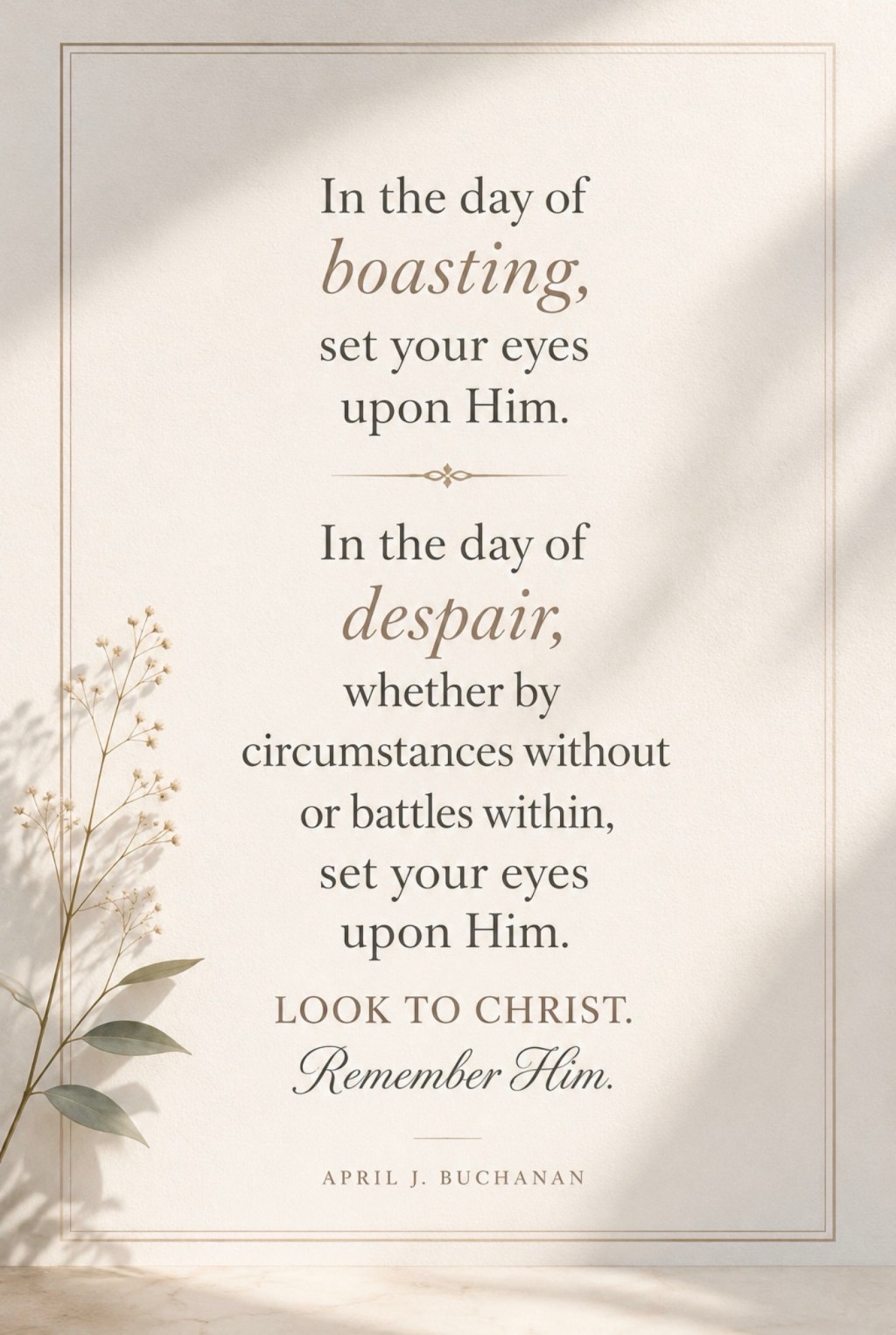
You may find in yourself cause for boasting and then find in yourself cause for despair, but in both you shall be shown that there is nothing in yourself worthy of either. Your mind shall again be informed by truth, and your heart humbled before the One who is faithful. In the day of boasting, set your eyes upon Him. In the day of despair, whether by circumstances without or battles within, set your eyes upon Him. Look to Christ. Remember Him.
For who can ever make it to that Celestial City apart from Him? The greatest threats are not outside but within. For the mind of man, with its many thoughts, and the heart of man, prone to wander, find within themselves troubles, pangs, and loves enough to destroy him in a day were it not for the grace of God. That grace upholds him in the day of adversity without and, much more, in his daily battle within.
Any man who professes Christ and has no struggle within himself against his sin has lost sight of Christ and His Word. Let the man who loves Christ set his eyes upon Him and find that gracious work within effectual and powerful against every foe, without and within.
Let him be careful when assimilation with the culture is no longer good and pleasing to God but instead leads his heart after their idols, their love of self, their hatred toward authority, and their claims to love God while showing themselves His enemy. Dear saint, guard your heart.
For many live as those of whom the Psalmist spoke when the kings of the earth conspired against God and His Anointed. Citizens and aliens alike, having assimilated themselves, devote undivided loyalty to their kings and kingdoms, defending even those “rights” that are contrary to God. They show their allegiance to their own happiness, comforts, prosperity, and protection at any cost.
The child of God in this world, whether alien or citizen, must first show himself a child of God and then, where God has placed him, honor Him there as a good citizen. The alien assimilating himself. The citizen obeying governing authorities as unto the Lord. Yet never so as to disobey God. For then he must stand where God stands and show his allegiance to Him, doing so as one who bears His name and represents Him before men.
Dear fellow pilgrim, your feet may travel far, but your heart and mind are prone to wander much farther. Is your hope anchored in Christ? Is your faith in Him alone? Wherever you are rooted, and wherever your feet may travel, be careful of your heart. If it is in allegiance to Christ, then you will honor Him there.
No matter how much difficulty there is in the world, we find within ourselves our greatest threat and battle. Resist the temptation to wander. Resist the temptation of the world to seek that which promises all your heart desires at the cost of compromising where your feet must firmly be planted.
Does your tender heart remain tender under the ever-increasing trials and tribulations of life? Has it found such grace as increases knowledge, strengthens the soul, and, while the heart grows wise, causes it to remain tender? Has knowledge increased alongside love abounding?
Or have the hardships of life and the striving of the soul, having found the exceeding sinfulness of sin and its increasing presence among men, caused the heart once broken for those dead in sin to now regard evangelism as time not well spent in prayer and activity? Has the wickedness of the world, and eyes now beholding sin as wicked and vile as it truly is, caused the heart to grow callous? Is the heart once tender now content to sit back and let God do the saving apart from the appointed means He has ordained, absolving itself of any responsibility to proclaim the Gospel whereby God works in regeneration?
Men well studied and not well lived are a contradiction to the work of grace. For it is grace that increases knowledge, and that not merely intellectual knowledge, but knowledge effectually wrought in the heart, changing the man and increasing his faith in God, whereby his life continues to demonstrate the power of God in him. A man whose life is contrary to increasing knowledge and genuine faith worked out in love is a man who ought to examine himself to see whether he is truly in the faith.
There are many who profess Christ and yet show themselves increasingly boastful and proud in their false doctrines, false beliefs, and false practices. Having their minds fixed in error, they resist the correction of Scripture and remain unwilling to submit their cherished beliefs to the test of God’s Word. Yet knowledge that is merely intellectual is not born of saving faith. True knowledge humbles the heart, exposes pride, and leads men to repentance and faith demonstrated in lives changed and being changed by the truth.
Dear saint, the heart is continually influenced by error. It does not naturally gravitate toward truth. Our bent is toward evil. We must be willing to admit this and put our hearts and minds to the Word, allowing it to straighten our crooked thinking. We must be humbled under its instruction, submitted to its commands, and take heed to its warnings and prohibitions. If we seek only what validates what we already want to believe and what makes us feel good, then we set our hearts on affirming our own errors and our own wickedness.
We do not naturally walk straight. We do not naturally think rightly. We must set our hearts and minds upon the truth, meditate upon it, understand our weaknesses, and discipline ourselves in the way of truth. The more that truth is worked in us, the more our hearts are changed, and the greater the influence of God’s Word becomes in our hearts and minds than the influence of the things we see and hear in the world.
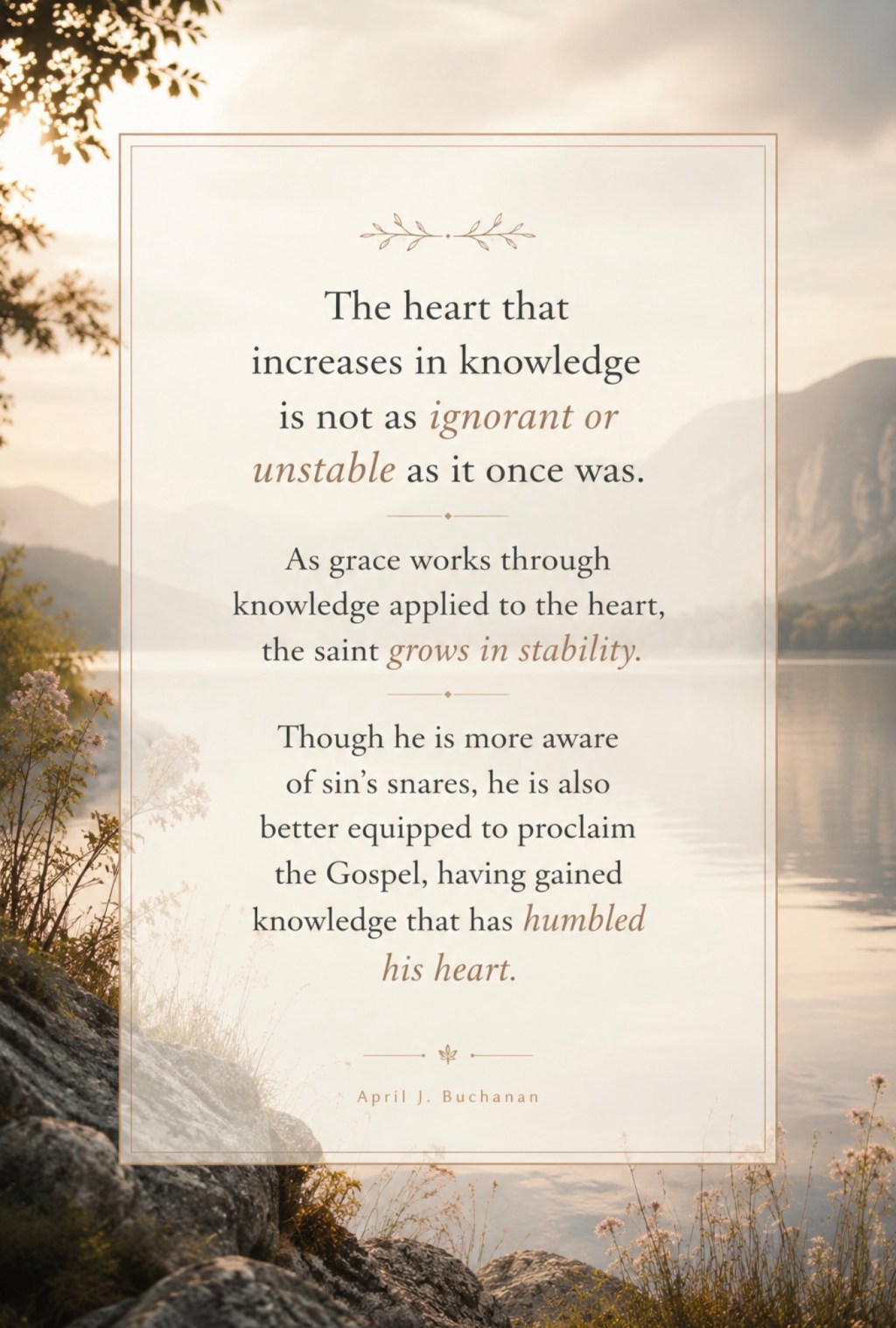
The heart that increases in knowledge is not as ignorant or unstable as it once was. As grace works through knowledge applied to the heart, the saint grows in stability. Though he is more aware of sin’s snares, he is also better equipped to proclaim the Gospel, having gained knowledge that has humbled his heart. He knows the grace that has kept him through every place from which he should never have risen again. His love for God has only increased in the knowledge of who He truly is.
He will neither diminish God’s glory to win the lost nor dismiss anyone as too far gone, for that judgment does not belong to him. His command is to proclaim the Gospel, and he will do so in love for every lost soul. He may be tempted to despair as many reject that external call, but God is faithful, and He will surely save all who come to Him in faith.
If he should draw his last breath never having witnessed one man repent and walk according to that faith, he will guard his heart from despair at the wickedness of men, trusting the God who is sovereign in salvation and glorified in obedience.
Dear saint, we tend to our hearts not by seeking what prompts emotional excitement, but by understanding our weaknesses and looking to Christ and His Word. Set your heart and mind upon His Word. This is not merely a glancing over the text or seeking some comfort from it. It is going into the text so that it may search our hearts and minds, exposing every error and bent within us.
For if we think all our ways are perfect, we are already deceived. Let His Word search me and show me my errors that they may be made straight. Let me never think I have arrived, that I am perfect, that I have no error or bent remaining in me, that all my thoughts are sound and all my ways are right. For when pride takes hold, I shall surely fall.
Dear saint, if we increase in knowledge with hearts that desire truth, we will never exhaust Scripture’s willingness to correct us, straighten us, and lead us forth in righteousness. And when we have been shown that which is straight, sound, and true, let us hold firm convictions according to sound doctrine. It is neither good nor safe to seek a false neutrality that nowhere exists. Where God has spoken, we may stand.
Firm convictions in sound doctrine, where grace abounds, are never apart from genuine love. If grace has its perfect work, it will always show itself in love, and never in opposition to truth. Let both be evident for Christ’s sake.
“The Lord knows.” “The Lord sees.” “God’s got me.”
Consider the beauty of these words on the lips of those who speak them rightly. How they honor God. How they express trust in His perfect knowledge, His righteous judgment, and His faithful care for His people.
Now consider how often these same words are found on the lips of those who have done what is wicked before God and against others, yet invoke His name in their own defense. How much worse is it for such as these?
The Lord does know. He does see. And He will act righteously.
Be careful of the man who has no fear of calling upon the Lord to defend him in his wickedness. Men who habitually lie often have no fear of God. They readily claim that God knows their hearts and sees the truth, seeking to place themselves in the position of righteousness while portraying those they have wronged as the villains.
Yet God does see.
Liars speak the native tongue of their father, the devil. Their hearts are set upon wickedness and falsehood. Though they invoke God’s name in their defense, He is not with them in their sin. Whether those they have wronged belong to Christ or not, God sees, and He judges righteously.
Unless this truth pierces their hearts and they are brought to genuine repentance and faith, they will continue in their self-justifications, convincing themselves that their evil is good and that God stands with them in it. They may not fear Him now, but they shall.
There is comfort here for the one who has been falsely accused, slandered, or mistreated. The Lord knows. The Lord sees. No lie escapes His notice. No injustice is hidden from His sight. His judgment is perfect, and His righteousness cannot be corrupted.
Yet there is also a warning for us. We must be careful what we say in God’s name, especially as His children. We know Him, and we represent Him before the world. We must not assume that because we belong to Him, we are always right, or that our words, thoughts, motives, and actions are automatically pleasing to Him.
The Lord does not defend our sin because we are His people. He disciplines those whom He loves. Therefore let us be quick to examine ourselves, slow to justify ourselves, and eager to repent where repentance is needed. Let us never presume upon God’s name to defend what He condemns.
The Lord knows. The Lord sees. And that truth is either a comfort or a warning.
What help is it to the body of Christ to invite guests on local shows or podcasts to share about themselves while never entering into the rich truths of Scripture? Why do some men play it so safe? Why can men of serious theological error or even a false teacher be platformed one week and a doctrinally sound preacher the next, yet no meaningful disagreement is ever explored and an appearance of shared faith and unity is promoted? Who benefits? Why are the questions so intentionally vague? Why is there no Gospel proclamation? Why is there no real discussion of Christ, who He is, and what He has accomplished? Why do the talking points center on the man rather than the Savior?
If we care about truth, our questions cannot remain superficial, subjective, or sentimental. They must be theological. They must arise from a desire for true worship. Questions that anyone can answer, heretics included, where there is no real possibility of a wrong answer, may appear to create unity, but they foster only a false unity.
The questions that deal honestly with Scripture, that expose a man’s beliefs and reveal the heart, are the very questions false teachers often refuse to face. Such questions strip away pretense, reveal error, and destroy the illusion of doctrinal neutrality.
Men who host programs where false teachers may feel comfortable and welcomed, while also inviting doctrinally sound teachers, yet carefully guide conversations away from areas of disagreement and toward themes about the men that give an appearance of unity and neutrality, show themselves undiscerning at best and unwilling to contend for truth at worst.
Those who love the truth do not fear discussions that delve deeply into Scripture and faithfully proclaim the Gospel.
Friend, be discerning of those who do not ask questions out of a genuine concern for truth but seek to create an appearance of unity where none exists. Truth necessarily distinguishes truth from error.
Consider the questions being asked. What do they lead toward, and what do they avoid? Do they preserve the appearance of unity by avoiding the beliefs, practices, and doctrines that would expose real and necessary differences? Do they reveal convictions grounded in Scripture, or a willingness to agree with everyone despite contradictory claims that cannot all be true?
Guided questions can be helpful, but they can also be intentionally crafted to avoid exposing falsehood and proclaiming truth. Such platforms may do great harm by creating the impression that false teachers and faithful teachers have far more in common than they actually do. False teachers often welcome such environments because they gain credibility and access to an audience that may lack discernment.
Does the platform glorify Christ or promote men? Are the questions centered upon Christ and His Gospel, or are they primarily concerned with what a man feels God is doing in him, how he believes he was called, and what he claims God is showing him?
Is Christ central? Is the Gospel central? Is the Word of God central?
If not, and if both truth and error are given the same platform while attention is directed toward personal experiences, impressions, and feelings, then the focus is no longer upon God but upon man. The individual is validated by his experiences rather than tested by Scripture.
Be careful of places where God is continually spoken of, yet the true purpose is to elevate men. Be careful of platforms where unity is prized more highly than truth.
Sin loves its own blindness and darkness of mind, for it cannot bear the light of exposure and lashes out against any who bear such light. It seeks out weakness in those men so as to turn the light away from itself and call them hypocrites. Anything to shield itself from seeing itself rightly. If men cannot bear the light that comes forth from those who are justified by faith in Christ and yet still struggle against their remaining sin, how will they bear perfect holiness? They cannot stand in the light of truth and suppress it forever, so how do they think they shall stand before God in all His holiness?
They know not what grace and mercy it is now to hear those who come to them and plead with them to repent and trust in Christ alone, nor the terror of the Lord that awaits those who despise the truth and the holiness of God. Finding refuge among those in the world who love their own, they show themselves to be God’s enemies. And yet, in His grace, He will gather all His own from the world unto Himself.
You know not your own blindness. You know not your own wickedness, for your heart has deceived you, O man. Wicked in your thinking, you imagine yourself wise, yet you play the fool. Upright in your own estimation, you set yourself in opposition to the truth that would show you already condemned before a holy God and reveal the only hope for your soul in Christ Jesus. You despise the truth, and your self-justification heaps up greater condemnation.
The truth you heard and rejected, that most holy thing which you found offensive and vile, shall rise in judgment against you. Those who proclaimed the truth to you, who bore witness to it in their lives, and whom you slandered as members of Christ’s bride, shall stand as a testimony against you. Your many sins, which you neither see nor understand because you would have no part in hearing the truth that exposes your wicked heart and possesses the power to save you, shall ever be before you.
You shall not escape the howling and haunting of it as judgment rains down upon your head forever. You despise the messenger who fears for your soul today, yet the truth he proclaimed shall testify against you then. Your sin shall not burn out in your heart, nor shall genuine repentance come forth from your lips. The truth from which you fled shall be the truth you cannot escape, forever bearing witness against you under the righteous judgment of God.
Because men hate the light, they hide in darkness and sometimes that darkness calls itself light and gathers in places that are churches where Satan has his seat. Unregenerate men and false teachers soothe the conscience of the wicked and assure them of a salvation that has never touched their lives, and they exploit them for their own wicked purposes. They each gain from one another what they desire, thereby showing themselves enemies of the truth.
For you are a sinner. You can find refuge in the world for a time. You can find refuge in false light. You can assuage your own conscience with falsehood. You can suppress the truth only for so long. For it will rise up in judgment against you. Your sins will find you out. You cannot atone for them. You cannot earn your freedom. You are in bondage to sin, and you love it. It is by the grace of God alone that your wicked heart may be made new and brought to see its own wickedness and folly, that very folly which you once loved and now find repulsive.
Unless you find God beautiful and His Word true, you shall never see yourself rightly. Unless faithful ministers declare the whole counsel of God and His Word is rightly proclaimed to your dead heart, set in opposition to Him, you shall remain blind in your sin. The very words you find most offensive are often the words God is pleased to use to bring life to the dead.
But if, O wretched man, you hear and God is pleased to work within you, then what you once hated you shall find most beautiful. The God whom you despised you shall love. The truth that once offended you shall become the delight of your soul.
And when you discover within yourself that which remains offensive to Him, you shall surely put it to death. For now your heart has been changed. The Word of God, once resisted as faithful men proclaimed it, has become your desire and your delight. You no longer seek refuge in falsehood and darkness, but in Christ alone.
In Christ you find genuine love, not the perversion your heart once devised. He is beautiful in His glory, though you have not yet beheld Him fully. Yet behold Him you shall, either with great terror or with great rejoicing.
Play not the fool. But as those precious saints who have died in the faith, who encouraged the souls of fellow saints amidst the darkness and wickedness of men, having set their hope upon Christ and trusted in His kind providence, dear saint, play the man.
The love of God reigning in the hearts of His children orders their affections rightly. Their loves, desires, and passions are set upon what God loves and set against what God hates. To the world, such love appears unloving. According to the world’s judgment, it is evil to hate what God hates and to love what God loves. Love must be redefined, affections distorted, and desires disordered before it can be called love by those who are opposed to God.
The world calls it love to affirm, celebrate, and stand alongside what is evil. Yet God calls His people to walk in love toward all, even toward those whose affections, desires, and passions are fixed upon the very things He hates. Such love is contrary to fallen human nature. It requires that a man be born again. His heart must be made new. His mind must continually be sanctified by the truth. The Spirit of God must dwell within him, so that his obedience is no longer mere pretense or reluctant duty, but the fruit of a new life with new affections and desires that glorify God.
The one whose loves were once disordered is made new and is being transformed. He now loves what he once hated and hates what he once loved, most especially the remaining sin within his own heart. The love God works within him produces rightly ordered affections. In loving others, he no longer judges according to his own desires or subjective feelings, but according to the Word of God, which speaks authoritatively concerning what is pure and impure, holy and defiled, sound and unsound, true and erroneous.
Let the heart that has found Christ most beautiful set itself continually upon Him. Let it guard itself from every temptation toward defilement, whether arising from inward corruption or from the pressures of a world that it is called to love, though not as the world loves.
Ordered affections will always expose disordered love. That which is most beautiful stands in contrast to that which is perverse, self-seeking, and devoted to its own comforts, happiness, and desires. Such things are not the love wrought by God in the hearts of His people. True love does not seek its own way. It considers others more significant than itself and is willing to suffer for the good of another when doing so glorifies God.
It is God who works in His people, conforming them more and more to the image of His Son. Therefore, the love He produces cannot but be rightly ordered, for its perfect demonstration has already been shown in Christ.
The world loves its own and seeks its own. This is not the love that God works. Much is called love that bears no resemblance to the love revealed in Scripture. The world loves whatever affirms, celebrates, and promotes its disordered passions set against God. Many who profess Christ know little of the love that calls sinners to repentance and faith, whereby those who are being saved have their affections and desires brought into right order.
The more we behold Christ, the more we love Him, and the more clearly we see. The less we look to Him, the more even the strongest saints may grow weary and faint in a world increasing in depravity, selfishness, self-love, and hatred toward God.
Remember the Lord, dear saint. Let your love abound still more and more in knowledge and all discernment, that it may glorify God. Fear not the opposition of men toward that love which speaks according to the truth and demonstrates itself in obedience to God. The world calls such love hatred because it cannot comprehend it. Yet should God be pleased to grant repentance and faith, those who once despised this love will come to know it for themselves. Then they shall rejoice in that very love they once opposed, for they will behold it fully in Christ.
Let not your love be confused with that of the world, but let it be established in the mind by truth, rightly ordered in the heart, and demonstrated in the life and doctrine of the saint who bears the name of Christ before the world.
The love of God reigning in the hearts of His children orders their affections rightly. Their loves, desires, and passions are set upon what God loves and set against what God hates. To the world, such love appears unloving. According to the world’s judgment, it is evil to hate what God hates and to love what God loves. Love must be redefined, affections distorted, and desires disordered before it can be called love by those who are opposed to God.
The world calls it love to affirm, celebrate, and stand alongside what is evil. Yet God calls His people to walk in love toward all, even toward those whose affections, desires, and passions are fixed upon the very things He hates. Such love is contrary to fallen human nature. It requires that a man be born again. His heart must be made new. His mind must continually be sanctified by the truth. The Spirit of God must dwell within him, so that his obedience is no longer mere pretense or reluctant duty, but the fruit of a new life with new affections and desires that glorify God.
The one whose loves were once disordered is made new and is being transformed. He now loves what he once hated and hates what he once loved, most especially the remaining sin within his own heart. The love God works within him produces rightly ordered affections. In loving others, he no longer judges according to his own desires or subjective feelings, but according to the Word of God, which speaks authoritatively concerning what is pure and impure, holy and defiled, sound and unsound, true and erroneous.
Let the heart that has found Christ most beautiful set itself continually upon Him. Let it guard itself from every temptation toward defilement, whether arising from inward corruption or from the pressures of a world that it is called to love, though not as the world loves.
Ordered affections will always expose disordered love. That which is most beautiful stands in contrast to that which is perverse, self-seeking, and devoted to its own comforts, happiness, and desires. Such things are not the love wrought by God in the hearts of His people. True love does not seek its own way. It considers others more significant than itself and is willing to suffer for the good of another when doing so glorifies God.
It is God who works in His people, conforming them more and more to the image of His Son. Therefore, the love He produces cannot but be rightly ordered, for its perfect demonstration has already been shown in Christ.
The world loves its own and seeks its own. This is not the love that God works. Much is called love that bears no resemblance to the love revealed in Scripture. The world loves whatever affirms, celebrates, and promotes its disordered passions set against God. Many who profess Christ know little of the love that calls sinners to repentance and faith, whereby those who are being saved have their affections and desires brought into right order.
The more we behold Christ, the more we love Him, and the more clearly we see. The less we look to Him, the more even the strongest saints may grow weary and faint in a world increasing in depravity, selfishness, self-love, and hatred toward God.
Remember the Lord, dear saint. Let your love abound still more and more in knowledge and all discernment, that it may glorify God. Fear not the opposition of men toward that love which speaks according to the truth and demonstrates itself in obedience to God. The world calls such love hatred because it cannot comprehend it. Yet should God be pleased to grant repentance and faith, those who once despised this love will come to know it for themselves. Then they shall rejoice in that very love they once opposed, for they will behold it fully in Christ.
Let not your love be confused with that of the world, but let it be established in the mind by truth, rightly ordered in the heart, and demonstrated in the life and doctrine of the saint who bears the name of Christ before the world.
There is confusion concerning biblical discipleship and spiritual warfare in many homes. Many parents are applying counterfeit doctrines that is said to be spiritual warfare and abandoning true biblical discipleship that is to the benefit of their children and home. The claim is that parents are on assignment to teach their children how to stand firm against the enemy. Following that claim are principles and practices that are nowhere found in Scripture and are leading many households after false doctrines and into much confusion and error.
Parents are indeed on assignment to teach their children how to stand firm against the enemy. However, that is not what many are taught it looks like in practice, and in doing so they miss the true beauty and power of the work of the Holy Spirit. This often happens when doctrines are not derived from sound exegesis of Scripture but have instead been imported into Scripture through the claims, experiences, and supposed revelations of men.
While Scripture certainly teaches that believers have an adversary and that spiritual warfare is real, the emphasis of Scripture is not upon raising children to become experts in identifying demonic activity, rebuking Satan, or discerning spiritual atmospheres. We are commanded to resist the devil, to stand firm in the faith, and to submit ourselves to God. Scripture does not present believers as those who engage Satan directly, rebuke him, or exercise authority over him. The focus of biblical spiritual warfare is steadfast faith, obedience, truth, prayer, and dependence upon God.
The assignment given to parents is far more God-centered. Parents are called to teach their children the Word of God, the character of God, the Gospel of Jesus Christ, His commandments, His promises, and the wisdom that flows from fearing Him. They are called to model lives that accord with sound doctrine and demonstrate the gracious work of the Holy Spirit in the heart.
When the Christian life is framed primarily around fighting the enemy, a subtle but significant shift occurs. The focus moves away from God and toward Satan. The enemy begins to loom larger than Scripture presents him. He becomes the explanation for every hardship, every conflict, every struggle, every minor inconvenience, and every instance of unusual behavior.
Children acting out of character, marital conflict, anxiety, fear, discouragement, and ordinary struggles of life become interpreted through the lens of spiritual attack rather than through the lens of God’s providence, human sinfulness, human weakness, or the ordinary realities of living in a fallen world. This framework is ultimately fear-driven. It trains believers to become preoccupied with the enemy rather than occupied with Christ.
Such teaching has tremendous potential to damage faith, discourage hope, and distort responsibility. When every problem is attributed to the enemy, personal responsibility is diminished. Sin becomes something done to us rather than something arising from within us. Repentance is obscured because the focus shifts away from the heart and toward external spiritual forces. Instead of examining themselves in light of God’s Word, people begin searching for spiritual explanations behind every difficulty. In the process, they often become less discerning, not more. They become highly sensitive to impressions, feelings, atmospheres, and perceived spiritual activity while becoming less attentive to the plain teaching of Scripture.
When children act out of character and parents have been shaped by this kind of teaching, they often do not respond with faith in God’s ordained means. Rather than examining the child’s behavior, addressing sin where it exists, teaching wisdom, providing correction, and pointing the child to Christ, they become fearful that the enemy has gained a foothold in their home. They begin responding to subjective internal impressions that they believe are warnings from the Holy Spirit. They employ practices that Scripture never prescribes, taking authority they do not possess, speaking directly to Satan, drawing spiritual boundaries around their homes, casting out demons, and engaging in various forms of spiritual warfare that are foreign to Scripture. What should have been an opportunity to open God’s Word becomes an opportunity to practice mystical techniques.
In these moments, children are deprived of what they truly need. They need parents who can explain why their behavior is sinful. They need parents who can teach them about God’s holiness and their need for forgiveness. They need parents who can point them to Christ and His Gospel. They need parents who can lovingly correct them according to Scripture and teach them how to walk in obedience. Instead, they often witness their parents reacting in fear to perceived spiritual threats. The child who expresses concern or confusion may be viewed as simply not understanding the spiritual warfare supposedly taking place for their benefit. What is presented as an act of faith is often driven more by fear than by trust in God’s revealed truth.
The tragedy is that while these parents believe they are accomplishing great things in the spiritual realm, they may actually be neglecting the very means God has ordained for spiritual growth and protection. They spend their time “speaking life” over their children, casting out demons, rebuking the enemy, and attempting to restore spiritual alignment within their homes. Yet in doing so they often overlook the far more dangerous reality that false doctrine itself has already entered the home. They fail to recognize that the enemy’s most effective work has frequently been accomplished not through obvious manifestations of evil, but through deception. Having been led away from sound doctrine, they become convinced that the solution to their problems lies in practices Scripture never commands rather than in the truth God has already revealed.
One of the most heartbreaking consequences of this teaching is the effect it can have upon children. How much damage is done when children hear their parents casting demons out of them every time they misbehave? How much confusion is created when normal struggles, sinful choices, emotional difficulties, or acts of immaturity are treated as evidence of demonic activity? Rather than learning the biblical categories of sin, repentance, forgiveness, sanctification, and growth, they learn to interpret their problems through a distorted spiritual lens. Instead of being taught that they need Christ, they are taught that their misbehavior is the fault of demons and that those demons may even be in them. Instead of learning responsibility, they learn suspicion and fear. Instead of hearing the Gospel, they hear constant warnings about spiritual attacks.
Scripture presents a far different picture of the Spirit’s work. The true work of the Holy Spirit is not found in believers shouting at Satan, issuing decrees, making declarations, or claiming authority over the spiritual realm. The Spirit works through the Word He inspired. He works through prayer directed toward God rather than conversations directed toward Satan. He works through the faithful preaching and teaching of Scripture. He works through conviction of sin, illumination of truth, sanctification of the believer, and the proclamation of the Gospel. The object of prayer is God. The focus of worship is God. The source of hope is God. The confidence of the believer rests not in his ability to subjectively discern spiritual threats but in Christ’s finished work and God’s sovereign care.
What makes this particularly difficult to address is that many who embrace these practices sincerely believe they are helping their families. The emotional intensity of such experiences often produces a sense of accomplishment and spiritual victory. Those who question these practices are viewed as lacking understanding, lacking faith, lacking spiritual discernment, or even lacking “Holy Spirit.” Yet sincerity does not transform error into truth. The emotional high that often accompanies these experiences can make it difficult for people to recognize the damage being done. They become convinced that they have protected their families when, in reality, they may be leading them further away from the simplicity and sufficiency of God’s Word.
This is not written to cast stones. It is written out of genuine concern. Many of us once believed and practiced these very things. Many of us were taught these doctrines and embraced them with complete sincerity. Looking back, we cannot undo the confusion they created or recover the opportunities that were missed. We cannot go back and replace those moments with clearer teaching, better instruction, or a more faithful application of Scripture. We can, however, publicly repent of our false beliefs and warn others about the same errors. We can trust in the sovereignty of God, knowing that even where we erred grievously, He remains faithful to work all things together for good and for His glory.
What makes it so heartbreaking is seeing others walk the same path while believing they are growing in spiritual maturity. They boast in practices that are harming the very people they desire to protect, all while neglecting the beautiful simplicity of God’s ordained means.
The answer is not found in stronger declarations, louder rebukes, greater emotional intensity, or increased confidence in perceived personal authority. The answer is found where it has always been found. Parents must teach the Word of God. They must point their children to Christ. They must proclaim the Gospel. They must pray to God rather than speak to Satan. They must trust the sufficiency of Scripture rather than their feelings and impressions. They must trust God who is sovereign. They must rely upon the ordinary means through which the Holy Spirit works. These means may appear simple to the world, but they possess a power far greater than all the techniques of modern spiritual warfare because they are the means ordained by God Himself.
Christ is enough. His Word is enough. The Gospel is enough.
Let my soul be anchored and firmly set in Your Word, corrected by it, instructed by it, sustained by it, and strengthened by Your grace, so that my mind may be fixed upon all that glorifies You.
For You know, O Lord, how prone I am to wander, how readily my heart inclines toward what is opposed to You. Yet You have worked so powerfully and effectually in this wayward heart: exposing its corruption, making it new, and leading it in the paths of righteousness, so that now it finds delight where once it found only ruin, and longs ever more for what is holy and true.
And yet I am not without remaining weakness. Were it not for Your gracious and powerful work of the Spirit within me, the tempter would surely prevail, and I would be consumed again in the conflict within. But even this struggle becomes a testimony, O God, that You are faithful, and that You will complete what You have begun.
How weak is the flesh, and how great is Your Word, Your Spirit, and the certainty of every promise You have spoken. I am not torn now between two masters or two loves. No, what once I embraced with affection, I now behold with sorrow and repulsion. And this is not to my boasting, but to the sweetness of Your grace at work within me, teaching me to hate evil and love what is good, to resist temptation, and to cleave to righteousness.
Even this warfare, O Lord, is the evidence of Your grace sustaining me, the proof of Your power preserving me, and the assurance of Your promise keeping me.
Do not let my heart grow weary in the waiting, nor be dulled by time, age, or repeated temptation, so that I forget the hope set before me. Let not this heart find its rest or satisfaction in anything apart from You, now and forevermore.
Lead me, O God of my righteousness. Set my heart and mind continually upon You.










 Leaving Beyond - Grounded In Scripture