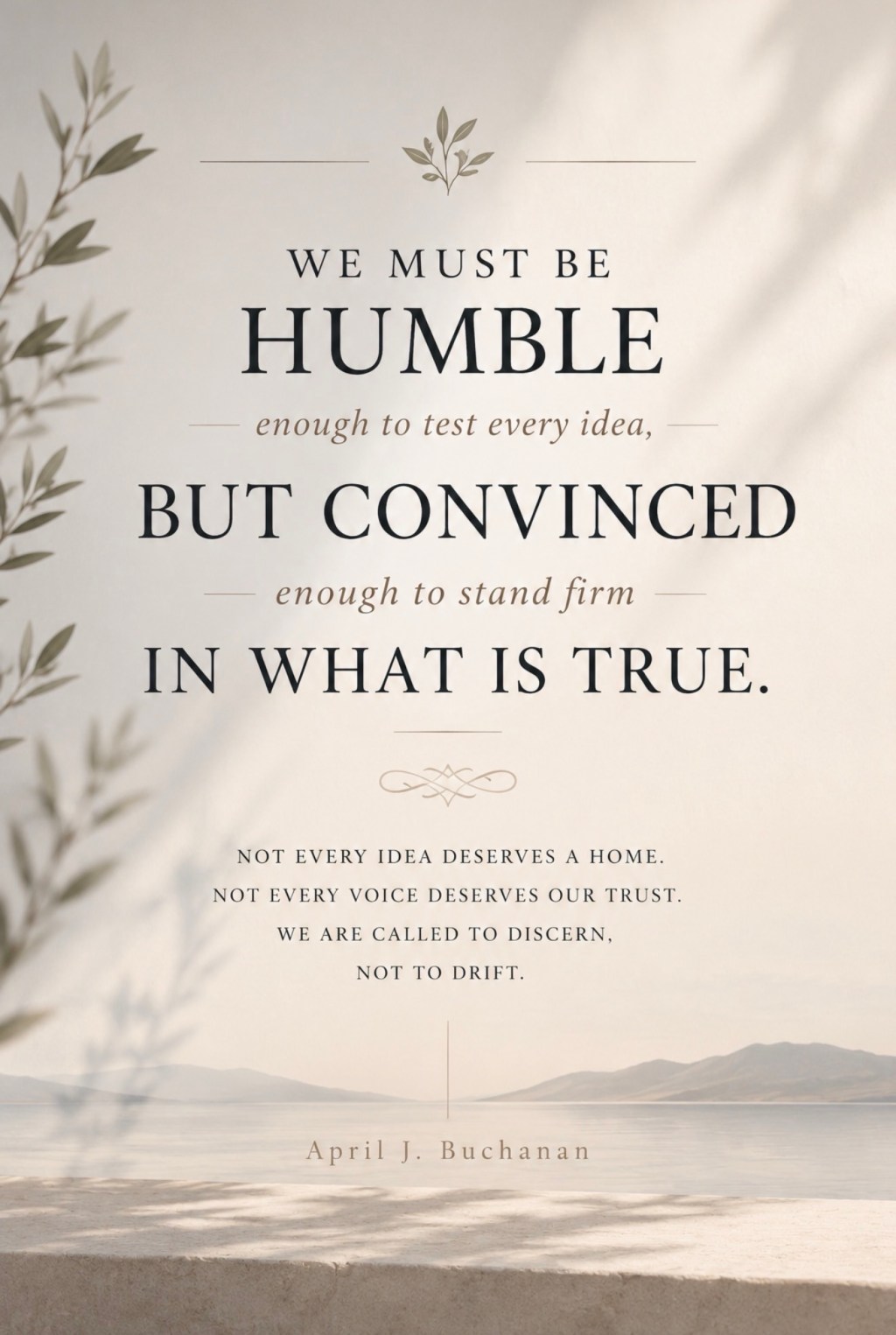
Written by: April J. Buchanan
There are those who create a “safe place” for questions and for “testing” beliefs. They are open and welcoming. They are friendly and have some “convictions” formed by their testing, yet they are often marked by an openness to being challenged and “corrected.” When you come out of bad theology and are fearful to enter another place where convictions are strong and unyielding, formed by the Word, tested, approved, sound, and proclaimed with authority, you may find yourself more comfortable in a place where you can test everything.
This place is often apologetics from a biblical worldview that encourages testing everything using Scripture and learning how to give a defense for what you believe. I use all that language in the beginning firmly and positively because as you grow in testing your beliefs against Scripture, this place often becomes less convincing and eventually a place that must be outgrown. A place that sets itself up as safe for testing beliefs and ideas against Scripture can, over time, reveal itself as a place where few real convictions are ever formed from Scripture itself.
As much as it sets itself in opposition to progressive Christianity that is open, inclusive, and welcoming of questions and different beliefs based on subjective experiences and ideas, with Scripture treated as merely another helpful tool rather than authoritative and sufficient, this increasingly popular apologetic world often has its own dangers as well. It is not all bad. There are some there who hold firm convictions based on the authority of Scripture. Yet this newer apologetic culture often feels compelled to remain perpetually “open.” Its foundation becomes the idea that one could always be wrong and must always remain willing to be shown otherwise. At first this sounds humble and careful. Yet if we never arrive at firm convictions grounded in Scripture, we become like those tossed to and fro.
When beliefs like evolution are introduced into the Christian worldview, when doctrines such as annihilationism are treated as acceptable possibilities within Christian orthodoxy, and when popular apologists insist they remain open to multiple positions on such matters, many begin to view foundational doctrines of the faith as matters of little importance.
There is a tendency in this world to stand outside of Scripture and never truly land in settled conviction based upon it, but instead to remain perpetually open, appearing humble, careful, and concerned for truth, yet never actually formed by it, convinced of it, changed by it, or able to proclaim it and let it speak. Scripture becomes something continually examined by man rather than unleashed as authoritative, powerful, transformative, and able to humble sinners and lead them into truth.
Apologetics have their rightful place in the Christian life, but if they become a world unto themselves they can become dangerous. Every Christian should be encouraged and strengthened in learning how to test beliefs and defend them according to what Scripture says and means. Yet many today are entering a world of apologetics where there is constant learning, engagement with competing worldviews, and increasingly blurred lines. What presents itself as wise, discerning, and impenetrable begins revealing susceptibility to deception through persuasive arguments, exposing a lack of settled conviction grounded in Scripture and a lack of being shaped by sound doctrine.
Apologetics are not inherently bad. It is biblical. They are good and useful in their proper place. Yet if we are not careful, we can create a place that sounds safe and open, welcoming every idea for examination, where regenerate and unregenerate alike gather in such a way that over time many who once appeared discerning begin themselves to be shaped by the very worldviews they once opposed. They begin mixing truth with error. They begin questioning doctrines long held within the Christian faith and biblical worldview. They cannot easily be pinned down as denying these doctrines because they remain “open.” They neither clearly reject foundational truths nor openly affirm what opposes them. Yet how can one truly defend convictions he himself remains unconvinced of them? And how can the heart and mind be shaped by sound doctrine while remaining perpetually open to error?
If one creates a safe place for testing beliefs, welcomes all ideas, encourages every man in his own way, and says he believes what he believes yet could always be convinced otherwise, not from humble submission to Scripture but from an unwillingness to arrive at settled conviction, he is not a safe guide. He is unstable. He is always studying yet never anchored. He holds positions only so long as they appear convincing, remaining perpetually open to abandoning them should something else appear more persuasive.
Friend, if our studying, testing, and searching of Scripture are not done in humility, with a sincere desire for truth, with minds and hearts convinced, shaped, and submitted to it, but instead from a posture that continually stands outside of Scripture and weighs it against competing worldviews to determine what sounds best to us, then how are we different from the world?
We must come to Scripture in pursuit of truth. The world of apologetics is often a mixed bag, and mixtures rarely end well. We do not purify error by mingling with it. We are called to proclaim the truth, not merely as participants in a battle of ideas, but with conviction of the truth and love for those in error, while also understanding our own weakness and susceptibility to deception.
Much of the apologetic world is not truly “safe.” It presents itself as a proper foundation where competing worldviews are challenged and Christians maintain fellowship despite disagreements. Politics have entered this arena as well, and even foundational doctrines are now regularly treated as open questions. There is a massive difference between testing and perpetual questioning. One goes to Scripture seeking truth and stands firmly in what it says. The other remains perpetually unconvinced, always “open” to being persuaded otherwise.
When I came out of bad theology, I found refuge among many apologists. I learned much from them about why we can trust our Bibles, how to test what is being said, how to recognize fallacious arguments, and similar helpful tools. Yet what I did not learn from them was settled conviction grounded in Scripture. I learned how to ask questions and conduct research, but I did not learn how to truly study my Bible or grow in sound doctrine.
Their tools and methods helped me learn not to blindly believe whatever I was taught simply because someone claimed authority, anointing, or special revelation. Yet they did not teach me how to rightly handle Scripture itself or how to grow in sound doctrine through its faithful exposition.
Then I found discernment ministries. These ministries helped me learn how to test sermons and teachings against what Scripture actually says. In different ways they helped expose how deeply deceived I had been and how blindly I had followed false teachers for so long. I learned that I had formed an entirely wrong way of hearing God and reading my Bible. It was deeply humbling as I listened to sharp and often well deserved rebukes that once described me as well. Yet even as I learned discernment and how to test all things, I still needed faithful exposition of Scripture itself in order to truly know what I was testing everything against.
Then came the pastors I had always been warned about, men said to be dull, dry, lifeless, lacking the Spirit, Pharisaical, or possessing a “religious spirit.” I began listening to them.
I approached their teaching ready to test everything against Scripture. I was ready to apply everything I had learned about discernment and testing. What I found instead were men opening the Scriptures in a way I had never encountered before. Nothing was obscured. The text itself was laid open plainly so that every man’s teaching could be examined in its light. These men were not claiming new revelation. They simply opened the text and let it speak.
All those years I thought I was “hearing God,” yet as these men preached verse by verse and book by book, I heard the voice of God in Scripture more clearly than I ever had before. My heart and mind were being changed and shaped by the Word itself. I did not abandon discernment under their teaching. Rather, applying what I had learned drove me deeper into Scripture, where I beheld the beauty and glory of God more clearly than ever before. There I encountered the true work of the Holy Spirit. There my love for God, His Word, His people, and His Gospel grew. I began to love the true voice of God in Scripture, the very voice I had once learned to silence and obscure.
As years have passed and I have spent more time under sound teaching, learning and testing all things so that my beliefs are anchored in Scripture, I remain grateful for apologetics in the life of believers, that we may give a defense for what we believe. I am grateful for faithful discernment ministries that help many learn to test all things according to sound doctrine. Yet most of all I am grateful to God for faithful pastors who preach the Word, warn against error, and whose ministry is not fragmented into isolated categories because under the authority of Scripture they rightly divide the Word of God and in doing so faithfully accomplish it all.
I find the most faithful work to which every believer should be pointed is that of sound churches, healthy churches being formed through the faithful exposition of biblically qualified elders. Find a doctrinally sound church and join it.
Grace and peace, dear precious saints.


Leave a Reply