Written by: April J. Buchanan
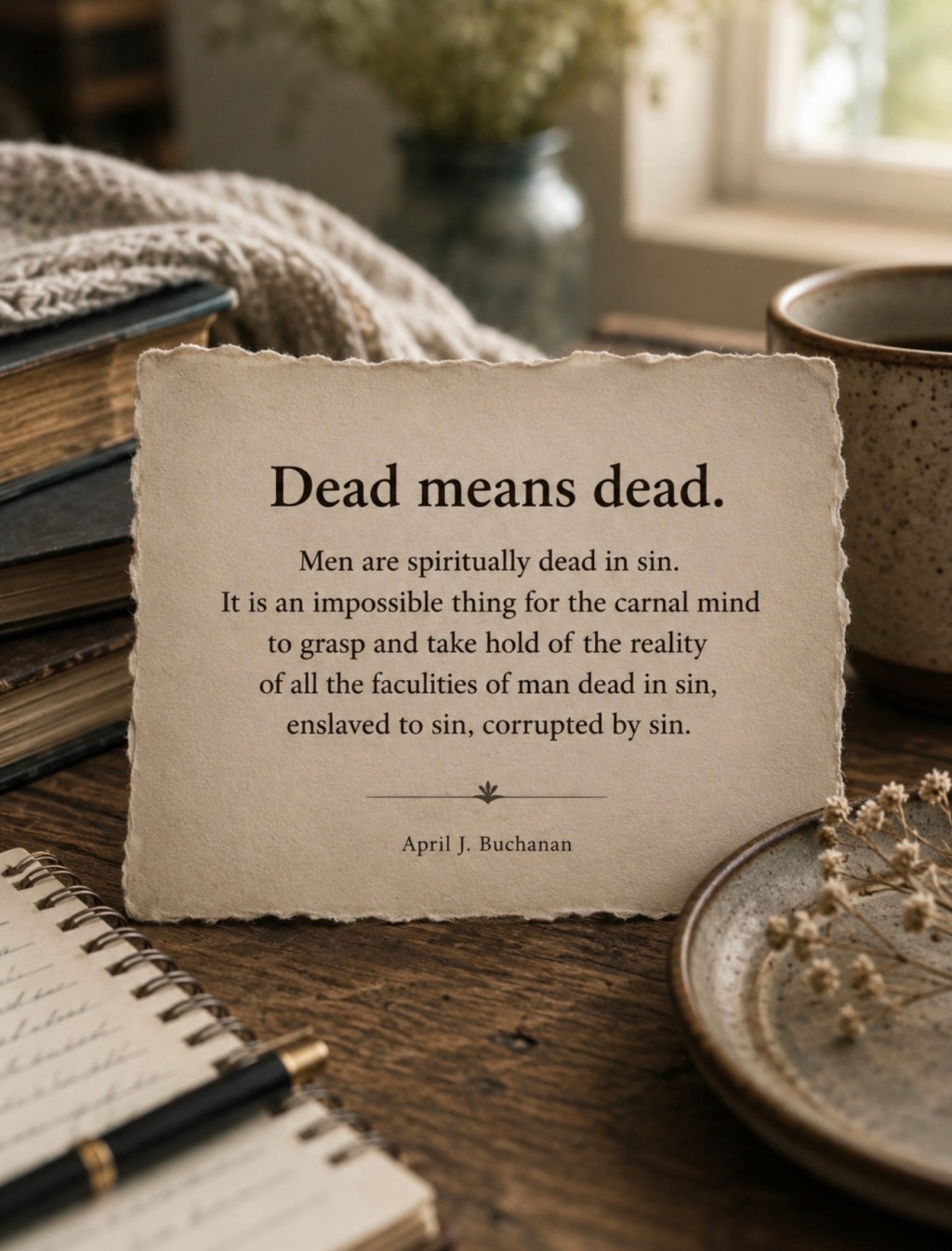
Dead means dead.
Men are spiritually dead in sin. It is an impossible thing for the carnal mind to grasp and take hold of the reality of all the faculties of man dead in sin, enslaved to sin, corrupted by sin. The heart arises in immediate protest against such a charge. The weight of that reality means there is no hope within himself of changing himself. It means that his good does not outweigh his bad. It means his works can’t save him. It means he is not as good as he thinks he is. It means the words of other men who lift his spirits on the bad days and tell him he’s a good man and everyone makes mistakes can’t help him. But it’s not this truth alone that crushes him under the weight and reality of where he stands before God. (Ephesians 2:1–3; Romans 3:10–18; Romans 8:7)
We must understand the words good and sin. If there is no God, then there is no objective moral right or wrong, and there is no holy or perfect law by which we have broken and there is no sin. Every man may then do what is right in his own eyes. If there is no God, then there is no perfect law that reveals what sinners we are, and if there is no such law, then there is no need for the Gospel, for again, if there is no God, then there’s no Christ, and if no Christ, there’s no hope, no salvation. (Romans 3:19–20; Romans 7:7; 1 Corinthians 15:17)
This is what wicked men think to find refuge in. They want Christian morality over and against other religious morality as if they think it is better for a culture, but they want it so much as it may not impose on their sins or call them to repentance and faith in Christ. They want Christian morality so long as it continues to provide some semblance of normalcy and reflects some semblance of objective truth and so long as it allows for safety and comfort. They want safety in their sins and comfort in their sins. They want some semblance of normalcy and not the extreme perversions of the world forced on them whereby they must call evil good. (Romans 1:18–25; John 3:19–20)
The law is written on our hearts. Even their desire for some semblance of normalcy and their rejection of being forced to call what is false true is a reflection of the imago Dei. It is the law written on their hearts, testifying to what is true and not wanting to submit their minds to delusion. (Romans 2:14–15)
They have already deceived their own souls. But they have standards. They think themselves better than they are. Their standards are not so based and depraved as other men. They will not be forced to give up what is evidentially true and be forced to call falsehood true, for they recognize that doing so is not only to abandon morality but to give up their minds to falsehood, and how far might they be made to go? It is not holding on to truth for the glory of God and because they love truth. No! They hold on for fear of what it may cost them. Many such as these simply do not care if such men who love falsehood and love perversion live as such. They will not stand in their way. To each man his own morality and pleasure so long as he does not force it upon another. (Romans 1:21–25; James 1:22)
Men love their pleasures, their false perception of their own perceived inherent goodness, and their own understanding of a god that they can satisfy or, if it pleases them better, to put God out of their minds and suppress the truth in their unrighteousness. Men are content to live amid depravity and moral degradation so long as laws reflect their own perceived inherent goodness. Men are content to live alongside moral degradation so long as it does not interrupt their way of life or influence those they love into a morality they consider offensive to their own. (Romans 1:18, 28–32; 2 Timothy 3:1–4)
Every man has his own standard of goodness, and it is that which he perceives to reflect his own inherent goodness. When men fall according to their own standard, they simply change it or do good in order to seek to appease their own conscience that accuses them and to satisfy God if they are willing to think of Him at all. (Romans 2:14–16; Luke 18:9–14)
The problem with Scripture rightly proclaimed is that men must hear the truth that crushes all men’s lofty-minded thinking of their own perceived inherent goodness. No man escapes perfect holiness revealing that there are none good. Not one. There are none righteous. All have sinned, and all have fallen short of the glory of God. The truth reveals that every man is dead in sin. Every man has broken God’s laws. There is none who does good. Not one. And the penalty for sin is death. (Romans 3:10–23; Ephesians 2:1; Romans 6:23)
How can this be? Is God not love? How can He judge men perfectly when to do so would be to the destruction of every man? God is holy. He is perfect. He is just. He is righteous. He is good. If men hear, “God is not mad at you. He loves you. He wants good for you,” as the invitation to be made right with God, then they fail to hear the truth of who God is and the terror that is so. The beauty and glory of God revealed in Christ to all who repent and believe in Him is diminished. Men think less of God because He is presented as being so smitten with them. (Romans 2:4–8; Hebrews 10:31; 1 John 4:8–10)
It is a cruel lie to tell one dead in sin that God is not mad at him. Scripture says that God is angry with the wicked every day. It is to diminish the glory of God in all His perfections. Such men set the love of God against His justice, righteousness, goodness, and holiness. Such men deceive their own souls and the souls of many who cannot bear to hear the weight and reality of the holiness of God that reveals their own sinfulness, and they find not His grace and mercy exceedingly beautiful. (Romans 1:18; Hebrews 10:26–31)
The reality is that God is holy. He is just. He is righteous. He is perfect. He is good. The goodness of God is not what men want to diminish it to. Goodness is a terror to men who are not good. It reveals how sinful we are. Only God is good. We are not good. When we hear the truth of who God is, we no longer cling to our wicked standards or perceived inherent goodness. We are faced with the reality of our own sins before a holy God. (Mark 10:18; Romans 3:19–20)
Where can we go? There’s nowhere to hide from God. But God has made a way that all who would come to Him shall be saved. God is both just and the justifier of wicked men. How can He be just and justify wicked men? Christ! (John 6:37; Romans 3:23–26)
The beauty and glory of God in His grace and mercy toward wicked men has been demonstrated simultaneously with His justice and righteousness in Christ alone. Jesus, being truly God and truly man, born of a virgin, took on flesh and lived the righteous life we could not and died the death, paying the penalty for wicked men, bearing the full wrath of God for sinful men, then rose three days later and now is seated at the right hand of the Father. (John 1:1, 14; 2 Corinthians 5:21; 1 Corinthians 15:3–4; Hebrews 10:12)
These are not mere words we learn intellectually and give feigned praise to a deity that took our place and now we can live as we so desire. As if God is satisfied and so we can be free to live as we so desire. No! God is holy! The work of salvation is the Triune work of God. The Father planned salvation, the Son secured redemption, and the Spirit applies that efficacious work of salvation. (Ephesians 1:3–14; Titus 3:4–7)
Spiritually dead men who clothe themselves in the language of religion and claim a relationship with God have no place with Him but in the lake of fire that does not go out. They have deceived their own souls. No man may enter but by grace alone through faith alone in Christ alone. (Matthew 7:21–23; Revelation 20:11–15; Ephesians 2:8–9)
The Gospel is for every man. Christ has come into the world to save sinners. He has borne the wrath of God and lived the righteous life we could not. His righteousness is sufficient for all who believe, and His substitutionary death actually secures the salvation of all for whom He died. The Gospel is proclaimed to every man, everywhere, with the command to repent and believe. He commands every man everywhere to repent, turn from your sins, agree with God concerning your sins before holiness, and believe on the Lord Jesus Christ for the salvation of your souls. (1 Timothy 1:15; Acts 17:30–31; Acts 16:31; 2 Corinthians 5:21)
Salvation is not merely being freed from guilt, shame, and a conscience that ever accuses, but reconciliation to a holy God. It is a holy God reconciling sinful men to Himself, whereby in Christ we who were once dead in sin have been made alive in Christ and given new desires, new affections that glorify God. We are given power that enables us to live and walk in the truth according to His grace at work in us, according to the Spirit at work in us. It is Spirit-empowered living. We are given new desires for His Word and fellowship with the saints and a genuine love for the lost, desiring that they may hear the Gospel so that they may be saved. (2 Corinthians 5:17–21; Ephesians 2:4–10; Galatians 5:16, 22–25; Philippians 2:12–13)
We who have been reconciled to God in Christ are compelled to proclaim the Gospel of salvation so that all men may be reconciled to God. It is the power of God that men may hear and believe. For many hear and do not hear. Many think themselves good with God. Many know not the reality of their own depravity, their own deadness, and the beauty and glory of God revealed in Christ Jesus. (2 Corinthians 5:18–20; Romans 1:16; Romans 10:13–17)
Oh man, come and hear while the day of salvation still rises upon you. Turn and believe, for mercy remains. But the day shall come when all that abides eternally upon sinful men is the holy wrath of God, and there is no mercy, no grace for such men. (2 Corinthians 6:2; Hebrews 10:26–31)
Come and hear. Come and see. Repent and believe on the Lord Jesus Christ. In Christ, God demonstrates His justice as Christ willingly bore the wrath of God for sinners, so that He is both just and justifies ungodly men. Today is the day of salvation. (Romans 3:25–26; Acts 16:31; 2 Corinthians 6:2)
Men once dead in sin may, in Christ, be made alive. (Ephesians 2:1–5; Colossians 2:13)


Leave a Reply